Truthbot
Verify Facts for yourselves
Look Up Facts
We are human and can make mistakes too. If you find something incorrect, feel free to point it out to us, and we will check it to see if your input is valid. We will not argue with any of you. Please be able to provide factual evidence, not a narrative.
This brief presents a documented, multi-layered case demonstrating that the United States federal government systematically circumvented First Amendment free speech protections.
It did so by leveraging its authority and relationships with private social media platforms to suppress content contradicting institutionally approved medical, scientific, and political consensus.
Rather than passing laws restricting speech, government agencies directed, pressured,
and coordinated with private platforms to restrict it on their behalf, a mechanism specifically designed to avoid direct constitutional accountability.
Verify Facts for yourselves
Medical Facts
Vit K Shots
Covid Shots -- Coming Soon
HantaVirus
Tetanus Shots
Polycythemia
Vera
Medbeds
Vaccines
Abortions
Vit K Shots
Covid Shots -- Coming Soon
HantaVirus
Tetanus Shots
Polycythemia
Vera
Medbeds
Vaccines
Abortions
Legal Facts
Reality about exemptions
to the law: driving, licenses, IRS payments,
etc.
Reality about exemptions
to the law: driving, licenses, IRS payments,
etc.
Media Facts
Was Trump telling the truth about the media lying?
Was Trump telling the truth about the media lying?
Look Up Facts
We are human and can make mistakes too. If you find something incorrect, feel free to point it out to us, and we will check it to see if your input is valid. We will not argue with any of you. Please be able to provide factual evidence, not a narrative.
This brief presents a documented, multi-layered case demonstrating that the United States federal government systematically circumvented First Amendment free speech protections.
It did so by leveraging its authority and relationships with private social media platforms to suppress content contradicting institutionally approved medical, scientific, and political consensus.
Rather than passing laws restricting speech, government agencies directed, pressured,
and coordinated with private platforms to restrict it on their behalf, a mechanism specifically designed to avoid direct constitutional accountability.
Look Up Facts
The Math They Never Showed You
In 1961, the American Academy of Pediatrics made the vitamin K shot mandatory for every newborn in America.
Here are the numbers behind that decision.
The only death data that existed came from one state. New York tracked newborn hemorrhagic deaths from 1981 to 1990. Ten years, one state. They found 32 deaths total.
Those 32 deaths were not even confirmed VKDB. The category included delivery trauma, premature infant bleeding, DIC from unrelated causes, and intraventricular hemorrhage. In 65% of those cases, medical records were too incomplete to confirm vitamin K deficiency as the cause.
Now do the math:
32 deaths ÷ 10 years = 3.2 deaths per year
Remove the 65% with incomplete or unconfirmable records:
3.2 x 0.65 = 2.08 unconfirmed cases removed
3.2 - 2.08 = 1.12 remaining cases per year
Cut that in half again to remove the other non-VKDB hemorrhagic causes mixed into the same category:
1.12 ÷ 2 = 0.56 possible VKDB deaths per year in New York State (which is one of the largest populated states that exist)
Now, multiply by 50 states:
0.56 x 50 = 28 possible VKDB deaths per year nationally, maximum.
Let's compare that to the birth rate:
4.3 million babies were born in 1960. That means the odds of a baby dying specifically from VKDB were approximately:
1 in 153,571. That is at the absolute outer limit.
It gets better:
In 1960 most mothers ate dramatically differently from today. Processed food was rare. Dark leafy greens, fermented foods, and organ meats were common staples. Maternal vitamin K intake directly raises vitamin K levels in breast milk. Better maternal diet meant better protected babies, naturally.
The real risk in 1960 was almost certainly lower than even these numbers suggest. So, what was the policy actually based on?
No national death tracking existed before 1980
No data existed at all before the policy was introduced in 1961
The only numbers available came from one state, two decades later
Those numbers mixed multiple causes of newborn bleeding together
65% of individual cases could not be confirmed
After removing unconfirmed and mixed cause deaths the real number drops to 28 possible cases, nationally, per year
A mandatory injection containing benzyl alcohol as a preservative, delivered at a dose 20,000 times what breast milk provides, was made standard procedure for every single newborn in America. That was based on numbers that did not exist yet. It was based on a condition affecting at most 1 in 153,571 births.
Do your own math. Ask your own questions. The data is available to anyone willing to look.
Sources:
ScienceDirect. "Newborn Hemorrhagic Disease Overview." New York State Department of Health review of infant mortality 1981 to 1990. https://www.sciencedirect.com/topics/pharmacology-toxicology-and-pharmaceutical-science/newborn-hemorrhagic-disease
NCBI PMC. "Mandating Vitamin K Prophylaxis for Newborns in New York State." Confirms 65% of reviewed deaths had incomplete or absent vitamin K documentation. https://pmc.ncbi.nlm.nih.gov/articles/PMC1695173/
NCBI StatPearls. "Hemorrhagic Disease of Newborn." Confirms the broader hemorrhagic category includes trauma, DIC, prematurity, and other non-VKDB causes. https://www.ncbi.nlm.nih.gov/books/NBK558994/
CDC WONDER. "Linked Birth and Infant Death Records." Confirms national standardized tracking begins no earlier than 2003 for ICD-10 coded data. https://wonder.cdc.gov/lbd.html
CDC NCHS. "Instructions for Classifying Causes of Death." Confirms automated cause of death classification only began in 1968. https://www.cdc.gov/nchs/nvss/manuals/2025/2b-2025.html
Greer F. "Vitamin K Status of Lactating Mothers and Their Infants." Confirms breast milk vitamin K concentration rises with maternal dietary intake. Acta Paediatrica, 1999. https://onlinelibrary.wiley.com/doi/abs/10.1111/j.1651-2227.1999.tb01308.x
CDC Historical Birth Data. U.S. births in 1960 approximately 4.3 million. https://www.cdc.gov/nchs/nvss/births.htm
Additional Important Info:
The Vitamin K Shot. The Numbers Nobody Added Up For You.
Every newborn in America gets a vitamin K shot within hours of birth. Here is what you actually need to know before you decide whether that makes sense for your baby.
First, the simple biology:
All babies are born with low vitamin K; Every single one. That part is true and not disputed anywhere in the science. Vitamin K does not cross the placenta well, so babies arrive with very little stored in their liver regardless of how healthy the mother is or how well she eats.
Most babies handle this just fine. The condition the shot is designed to prevent, called Vitamin K Deficiency Bleeding or VKDB, develops in at most 1.7% of unprotected newborns. That means roughly 98 out of every 100 babies born with the same low vitamin K levels never develop the problem at all.
Now here is something nobody tells you at the hospital:
There are virtually no reports of VKDB occurring in infants who are formula fed. Formula contains approximately 55 micrograms of vitamin K per liter compared to just 1 to 9 micrograms per liter in breast milk. University of Rochester Medical Center
The daily intake of vitamin K by exclusively breastfed babies is less than 0.2 micrograms per day, whereas the vitamin K intake of infants fed with formula was 50 micrograms per day.
Formula fed infants had vitamin K levels within the normal adult range at all study points. The low vitamin K levels in breastfed infants were not associated with hemorrhagic disorders or coagulation abnormalities. Cambridge Core
Read that last sentence again. Low vitamin K levels in breastfed infants were not associated with bleeding disorders or clotting problems in that study.
So what are the actual numbers?
We already did this math using the only death tracking data that existed, the New York State review from 1981 to 1990. Here is the honest count once again, for those of you who missed it.
After removing unconfirmed cases and mixed cause deaths:
Approximately 28 possible VKDB deaths per year nationally - Maximum.
Against 4.3 million births per year. Odds of roughly 1 in 153,571.
Now, here is what the shot actually contains:
The standard vitamin K injection contains benzyl alcohol as a preservative. The manufacturer's own prescribing label states that serious and fatal reactions including gasping syndrome can occur in newborns treated with benzyl alcohol preserved drugs, and that preservative free formulations should be used in newborns whenever possible.
Documented reactions to benzyl alcohol in newborns listed on the manufacturer's own label include neurological deterioration, seizures, intracranial hemorrhage, liver failure, kidney failure, low blood pressure, slow heart rate, and cardiovascular collapse.
The shot delivers a dose 20,000 times what breast milk provides into a liver the research confirms is immature and less efficient at processing vitamin K than an adult liver.
Here is what WHO's own documents reveal:
The WHO actually carries two separate recommendations simultaneously. The first says give every newborn the shot. The second says only give it to high risk newborns including those with birth trauma, premature birth, or whose mothers took certain medications.
The blanket mandate for every single baby is not even a universally agreed upon position within the organization that recommends it.
Here is what the shot cannot do:
The early form of VKDB, which occurs within the first 24 hours of birth, cannot be prevented by the shot regardless of when it is given. That is confirmed in the peer reviewed literature. One of the three forms of the condition the shot is given to prevent cannot be prevented by the shot under any circumstances.
Let's do this in plain language:
If your baby is formula fed, the research shows virtually no risk of VKDB. Formula provides 55 micrograms of vitamin K per liter compared to breast milk's 1 to 9 micrograms. Formula fed babies maintain normal adult range vitamin K levels throughout infancy.
If you are breastfeeding, a simpler option exists. Maternal supplementation with vitamin K increases milk vitamin K levels significantly and can improve vitamin K status in breastfed infants.
Several European countries use oral vitamin K drops as standard practice instead of the injection entirely. ScienceDirect
A mandatory injection containing a preservative the manufacturer says should be avoided in newborns, delivering a dose 20,000 times what breast milk provides, with an unconfirmed storage and release mechanism, that cannot prevent one of the three conditions it is given for, was introduced in 1961 for a condition affecting at most 1 in 153,571 births based on death data that did not yet exist.
Formula feeding eliminates the primary risk factor entirely. Maternal vitamin K supplementation raises breast milk levels significantly. Oral drops work in multiple countries as an alternative.
Nobody is telling you that at the hospital. Why?
Read the documents. Ask the questions. Make your own informed decision.
Sources:
Evidence Based Birth. "Evidence on the Vitamin K Shot in Newborns." Confirms formula contains 55 micrograms per liter vs 1 to 9 in breast milk and virtually no VKDB in formula fed infants. https://evidencebasedbirth.com/evidence-for-the-vitamin-k-shot-in-newborns/
"Vitamin K and the Newborn: A Correction." Confirms infant formula contains 54 to 105 micrograms of vitamin K per liter.
https://www.nejm.org/doi/full/10.1056/NEJM199401063300119 New England Journal of Medicine.
"Maternal Supplementation and Vitamin K in Breast Milk." Confirms daily vitamin K intake of exclusively breastfed babies less than 0.2 micrograms vs 50 micrograms per day in formula fed infants. https://www.clinician.com/articles/57036-maternal-supplementation-and-vitamin-k-in-breast-milk Clinician.com.
"The Effect of Formula Versus Breast Feeding and Exogenous Vitamin K Supplementation on Circulating Levels of Vitamin K." Confirms formula fed infants maintained normal adult range vitamin K levels and low breastfed infant levels were not associated with hemorrhagic disorders. https://pubmed.ncbi.nlm.nih.gov/8444211/ PubMed.
"Vitamin K." Confirms maternal supplementation increases breast milk vitamin K levels significantly. https://www.ncbi.nlm.nih.gov/books/NBK500922/
NCBI PMC. (NCBI LactMed.)
"Vitamin K Prophylaxis in Newborns." Confirms early VKDB cannot be prevented by the shot and confirms WHO dual conflicting recommendations. https://www.ncbi.nlm.nih.gov/pmc/articles/PMC8424792/
Pfizer Vitamin K1 Injection Prescribing Information. FDA label. Confirms benzyl alcohol content, gasping syndrome risk, documented adverse reactions, and manufacturer recommendation to use preservative free formulations in newborns. https://labeling.pfizer.com/ShowLabeling.aspx?id=4669
"Vitamin K Shot in Newborn Babies." Confirms WHO dual recommendations and unconfirmed muscle storage and release mechanism. https://www.ncbi.nlm.nih.gov/pmc/articles/PMC9184874/ NCBI PMC.
Here are the numbers behind that decision.
The only death data that existed came from one state. New York tracked newborn hemorrhagic deaths from 1981 to 1990. Ten years, one state. They found 32 deaths total.
Those 32 deaths were not even confirmed VKDB. The category included delivery trauma, premature infant bleeding, DIC from unrelated causes, and intraventricular hemorrhage. In 65% of those cases, medical records were too incomplete to confirm vitamin K deficiency as the cause.
Now do the math:
32 deaths ÷ 10 years = 3.2 deaths per year
Remove the 65% with incomplete or unconfirmable records:
3.2 x 0.65 = 2.08 unconfirmed cases removed
3.2 - 2.08 = 1.12 remaining cases per year
Cut that in half again to remove the other non-VKDB hemorrhagic causes mixed into the same category:
1.12 ÷ 2 = 0.56 possible VKDB deaths per year in New York State (which is one of the largest populated states that exist)
Now, multiply by 50 states:
0.56 x 50 = 28 possible VKDB deaths per year nationally, maximum.
Let's compare that to the birth rate:
4.3 million babies were born in 1960. That means the odds of a baby dying specifically from VKDB were approximately:
1 in 153,571. That is at the absolute outer limit.
It gets better:
In 1960 most mothers ate dramatically differently from today. Processed food was rare. Dark leafy greens, fermented foods, and organ meats were common staples. Maternal vitamin K intake directly raises vitamin K levels in breast milk. Better maternal diet meant better protected babies, naturally.
The real risk in 1960 was almost certainly lower than even these numbers suggest. So, what was the policy actually based on?
No national death tracking existed before 1980
No data existed at all before the policy was introduced in 1961
The only numbers available came from one state, two decades later
Those numbers mixed multiple causes of newborn bleeding together
65% of individual cases could not be confirmed
After removing unconfirmed and mixed cause deaths the real number drops to 28 possible cases, nationally, per year
A mandatory injection containing benzyl alcohol as a preservative, delivered at a dose 20,000 times what breast milk provides, was made standard procedure for every single newborn in America. That was based on numbers that did not exist yet. It was based on a condition affecting at most 1 in 153,571 births.
Do your own math. Ask your own questions. The data is available to anyone willing to look.
Sources:
ScienceDirect. "Newborn Hemorrhagic Disease Overview." New York State Department of Health review of infant mortality 1981 to 1990. https://www.sciencedirect.com/topics/pharmacology-toxicology-and-pharmaceutical-science/newborn-hemorrhagic-disease
NCBI PMC. "Mandating Vitamin K Prophylaxis for Newborns in New York State." Confirms 65% of reviewed deaths had incomplete or absent vitamin K documentation. https://pmc.ncbi.nlm.nih.gov/articles/PMC1695173/
NCBI StatPearls. "Hemorrhagic Disease of Newborn." Confirms the broader hemorrhagic category includes trauma, DIC, prematurity, and other non-VKDB causes. https://www.ncbi.nlm.nih.gov/books/NBK558994/
CDC WONDER. "Linked Birth and Infant Death Records." Confirms national standardized tracking begins no earlier than 2003 for ICD-10 coded data. https://wonder.cdc.gov/lbd.html
CDC NCHS. "Instructions for Classifying Causes of Death." Confirms automated cause of death classification only began in 1968. https://www.cdc.gov/nchs/nvss/manuals/2025/2b-2025.html
Greer F. "Vitamin K Status of Lactating Mothers and Their Infants." Confirms breast milk vitamin K concentration rises with maternal dietary intake. Acta Paediatrica, 1999. https://onlinelibrary.wiley.com/doi/abs/10.1111/j.1651-2227.1999.tb01308.x
CDC Historical Birth Data. U.S. births in 1960 approximately 4.3 million. https://www.cdc.gov/nchs/nvss/births.htm
Additional Important Info:
The Vitamin K Shot. The Numbers Nobody Added Up For You.
Every newborn in America gets a vitamin K shot within hours of birth. Here is what you actually need to know before you decide whether that makes sense for your baby.
First, the simple biology:
All babies are born with low vitamin K; Every single one. That part is true and not disputed anywhere in the science. Vitamin K does not cross the placenta well, so babies arrive with very little stored in their liver regardless of how healthy the mother is or how well she eats.
Most babies handle this just fine. The condition the shot is designed to prevent, called Vitamin K Deficiency Bleeding or VKDB, develops in at most 1.7% of unprotected newborns. That means roughly 98 out of every 100 babies born with the same low vitamin K levels never develop the problem at all.
Now here is something nobody tells you at the hospital:
There are virtually no reports of VKDB occurring in infants who are formula fed. Formula contains approximately 55 micrograms of vitamin K per liter compared to just 1 to 9 micrograms per liter in breast milk. University of Rochester Medical Center
The daily intake of vitamin K by exclusively breastfed babies is less than 0.2 micrograms per day, whereas the vitamin K intake of infants fed with formula was 50 micrograms per day.
Formula fed infants had vitamin K levels within the normal adult range at all study points. The low vitamin K levels in breastfed infants were not associated with hemorrhagic disorders or coagulation abnormalities. Cambridge Core
Read that last sentence again. Low vitamin K levels in breastfed infants were not associated with bleeding disorders or clotting problems in that study.
So what are the actual numbers?
We already did this math using the only death tracking data that existed, the New York State review from 1981 to 1990. Here is the honest count once again, for those of you who missed it.
After removing unconfirmed cases and mixed cause deaths:
Approximately 28 possible VKDB deaths per year nationally - Maximum.
Against 4.3 million births per year. Odds of roughly 1 in 153,571.
Now, here is what the shot actually contains:
The standard vitamin K injection contains benzyl alcohol as a preservative. The manufacturer's own prescribing label states that serious and fatal reactions including gasping syndrome can occur in newborns treated with benzyl alcohol preserved drugs, and that preservative free formulations should be used in newborns whenever possible.
Documented reactions to benzyl alcohol in newborns listed on the manufacturer's own label include neurological deterioration, seizures, intracranial hemorrhage, liver failure, kidney failure, low blood pressure, slow heart rate, and cardiovascular collapse.
The shot delivers a dose 20,000 times what breast milk provides into a liver the research confirms is immature and less efficient at processing vitamin K than an adult liver.
Here is what WHO's own documents reveal:
The WHO actually carries two separate recommendations simultaneously. The first says give every newborn the shot. The second says only give it to high risk newborns including those with birth trauma, premature birth, or whose mothers took certain medications.
The blanket mandate for every single baby is not even a universally agreed upon position within the organization that recommends it.
Here is what the shot cannot do:
The early form of VKDB, which occurs within the first 24 hours of birth, cannot be prevented by the shot regardless of when it is given. That is confirmed in the peer reviewed literature. One of the three forms of the condition the shot is given to prevent cannot be prevented by the shot under any circumstances.
Let's do this in plain language:
If your baby is formula fed, the research shows virtually no risk of VKDB. Formula provides 55 micrograms of vitamin K per liter compared to breast milk's 1 to 9 micrograms. Formula fed babies maintain normal adult range vitamin K levels throughout infancy.
If you are breastfeeding, a simpler option exists. Maternal supplementation with vitamin K increases milk vitamin K levels significantly and can improve vitamin K status in breastfed infants.
Several European countries use oral vitamin K drops as standard practice instead of the injection entirely. ScienceDirect
A mandatory injection containing a preservative the manufacturer says should be avoided in newborns, delivering a dose 20,000 times what breast milk provides, with an unconfirmed storage and release mechanism, that cannot prevent one of the three conditions it is given for, was introduced in 1961 for a condition affecting at most 1 in 153,571 births based on death data that did not yet exist.
Formula feeding eliminates the primary risk factor entirely. Maternal vitamin K supplementation raises breast milk levels significantly. Oral drops work in multiple countries as an alternative.
Nobody is telling you that at the hospital. Why?
Read the documents. Ask the questions. Make your own informed decision.
Sources:
Evidence Based Birth. "Evidence on the Vitamin K Shot in Newborns." Confirms formula contains 55 micrograms per liter vs 1 to 9 in breast milk and virtually no VKDB in formula fed infants. https://evidencebasedbirth.com/evidence-for-the-vitamin-k-shot-in-newborns/
"Vitamin K and the Newborn: A Correction." Confirms infant formula contains 54 to 105 micrograms of vitamin K per liter.
https://www.nejm.org/doi/full/10.1056/NEJM199401063300119 New England Journal of Medicine.
"Maternal Supplementation and Vitamin K in Breast Milk." Confirms daily vitamin K intake of exclusively breastfed babies less than 0.2 micrograms vs 50 micrograms per day in formula fed infants. https://www.clinician.com/articles/57036-maternal-supplementation-and-vitamin-k-in-breast-milk Clinician.com.
"The Effect of Formula Versus Breast Feeding and Exogenous Vitamin K Supplementation on Circulating Levels of Vitamin K." Confirms formula fed infants maintained normal adult range vitamin K levels and low breastfed infant levels were not associated with hemorrhagic disorders. https://pubmed.ncbi.nlm.nih.gov/8444211/ PubMed.
"Vitamin K." Confirms maternal supplementation increases breast milk vitamin K levels significantly. https://www.ncbi.nlm.nih.gov/books/NBK500922/
NCBI PMC. (NCBI LactMed.)
"Vitamin K Prophylaxis in Newborns." Confirms early VKDB cannot be prevented by the shot and confirms WHO dual conflicting recommendations. https://www.ncbi.nlm.nih.gov/pmc/articles/PMC8424792/
Pfizer Vitamin K1 Injection Prescribing Information. FDA label. Confirms benzyl alcohol content, gasping syndrome risk, documented adverse reactions, and manufacturer recommendation to use preservative free formulations in newborns. https://labeling.pfizer.com/ShowLabeling.aspx?id=4669
"Vitamin K Shot in Newborn Babies." Confirms WHO dual recommendations and unconfirmed muscle storage and release mechanism. https://www.ncbi.nlm.nih.gov/pmc/articles/PMC9184874/ NCBI PMC.
Look Up Facts
The Hantavirus Timeline Nobody Is Talking About
People deserve to see these facts laid out in order. You might wish to read them slowly.
"What does it actually mean in Hungarian? In Hungarian, “hanta” means lies, bluff, or nonsense talk —basically saying someone is not telling the truth."
"Usage: It’s informal and can sound playful or dismissive, depending on the context. For example, “Ne hanta!” means “Don’t bluff” or “Don’t lie”."
"Extra note"
"Some sources mention folk or regional variants, but the most common modern meaning is the one above."
https://trendsmask.com/what-does-hanta-mean-in-hungarian-690737.html
"What does it actually mean in Hungarian? In Hungarian, “hanta” means lies, bluff, or nonsense talk —basically saying someone is not telling the truth."
"Usage: It’s informal and can sound playful or dismissive, depending on the context. For example, “Ne hanta!” means “Don’t bluff” or “Don’t lie”."
"Extra note"
"Some sources mention folk or regional variants, but the most common modern meaning is the one above."
https://trendsmask.com/what-does-hanta-mean-in-hungarian-690737.html
December 2020
COVID mRNA vaccines begin rolling out globally.
February 2021
Pfizer's own internal document, the 5.3.6 Cumulative Analysis of Post-Authorization Adverse Event Reports, lists "Hantavirus Pulmonary Infection" as an Adverse Event of Special Interest for monitoring after rollout. The document covers data through February 28, 2021. No patient receiving the COVID vaccine was told this condition was on Pfizer's watchlist. ScienceDirect
Early 2021
Moderna begins exploring collaboration on a hantavirus vaccine as early as 2021. ScienceDirect
September 2022
The University of Texas System files a patent application for an mRNA vaccine specifically targeting hantavirus, including the Andes virus strain. CDC
January 2023
The U.S. Department of Defense awards UTMB up to $24.7 million to conduct preclinical evaluation and human clinical trials for mRNA vaccine candidates developed by Moderna in collaboration with UTMB researcher Dr. Alexander Bukreyev, the same inventor named on the hantavirus patent. ScienceDirect
September 2023
Moderna formally signs a research and development agreement with Korea University's Vaccine Innovation Center to jointly develop an mRNA hantavirus vaccine. ScienceDirect
August 2024
UTMB publishes successful animal trial results for an mRNA vaccine against Andes virus, the specific hantavirus strain now circulating on the MV Hondius cruise ship. ScienceDirect
April 2025
University of Texas mRNA hantavirus patent published publicly.
May 7, 2026
Moderna announces positive Phase 1 data for its mRNA hantavirus vaccine. The results showed the vaccine was well-tolerated and generated strong immune responses across all dose levels. ScienceDirect
That same day
Moderna stock jumps 10% as concerns mount over the hantavirus outbreak aboard the MV Hondius cruise ship. ICD10Data
May 8, 2026
Nine suspected cases and six confirmed cases of hantavirus linked to the MV Hondius, with three deaths. The specific strain is Andes virus, the only hantavirus known to be capable of human to human transmission. Infected passengers are now hospitalized across five countries. NCBI
Now notice what this actually is:
The strain in the current outbreak is Andes virus. That is the exact strain Moderna and the University of Texas specifically developed their mRNA vaccine to target. Not hantavirus in general. No, the specific one.
The Andes virus has a fatality rate between 20% and 40%. There is currently no approved treatment or cure. New England Journal of Medicine
Moderna told Newsweek their hantavirus work reflects their "broader responsibility to develop countermeasures against emerging infectious diseases." ScienceDirect
A company with a ready vaccine. A patent filed four years before the outbreak. Department of Defense funding attached. Phase 1 data announced the same day the outbreak made international headlines. Stock up 10%.
We are not telling you what to think. We are showing you the documented timeline and asking you to think for yourself.
We will be tracking every death attributed to this outbreak as it develops. We will update this post with verified numbers as they are confirmed, not as they are claimed.
Bookmark this. Share it. Watch the numbers.
Sources:
Pfizer 5.3.6 Cumulative Analysis of Post-Authorization Adverse Event Reports, Appendix 1. Released via FOIA. https://phmpt.org/wp-content/uploads/2021/11/5.3.6-postmarketing-experience.pdf
Brussels Signal. "Korea University and Moderna Have Been Working on mRNA Hantavirus Vaccine Since 2023." May 2026. https://brusselssignal.eu/2026/05/korea-university-and-moderna-have-been-working-on-mrna-hantavirus-vaccine-since-2023/
UTMB News. "UTMB Awarded Project Agreement Up to $24.7M from the U.S. Department of Defense." January 2023. https://www.utmb.edu/pathology/research-laboratories/the-bukreyev-lab/news/2023/01/31/utmb-awarded-project-agreement-from-the-us-department-of-defense-to-develop-mrna-vaccines
Google Patents. US20250127870A1. mRNA Vaccines Against Hantavirus. Filed September 13, 2022. https://patents.google.com/patent/US20250127870A1/en
UTMB News. "UTMB Study Shows Success With New Vaccines to Prevent Andes Virus." August 2024. https://www.utmb.edu/news/article/utmb-news/2024/08/05/utmb-study-shows-success-with-new-vaccines-to-prevent-andes-virus
Investing.com. "Moderna Stock Climbs After Hantavirus Vaccine Data Triggers Analyst Price Target." May 7, 2026. https://www.investing.com/analysis/moderna-stock-climbs-after-hantavirus-vaccine-data-triggers-analyst-price-target-200679973
Investing.com. "Moderna Stock Jumps 10% Amid Hantavirus Outbreak Concerns." May 7, 2026. https://finance.yahoo.com/sectors/healthcare/articles/moderna-stock-jumps-10-amid-140754662.html
WHO Disease Outbreak News. "Hantavirus Cluster Linked to Cruise Ship Travel." May 4, 2026. https://www.who.int/emergencies/disease-outbreak-news/item/2026-DON599
The Hill. "5 Things to Know About Hantavirus After Cruise Ship Outbreak." May 2026. https://thehill.com/policy/healthcare/5868519-hantavirus-outbreak-public-health/
Newsweek. "Hantavirus Stirs Vaccine Skeptics, Moderna Questions, Prediction Conspiracy." May 2026. https://www.newsweek.com/did-moderna-start-developing-hantavirus-mrna-vaccine-in-2024-what-we-know-11924648
Before You Share the Hantavirus Posts Going Around: Above, we present verified information regardless of which direction it cuts. Several claims circulating about the current hantavirus outbreak need to be addressed honestly, though, so that is what we will also be doing.
Claim 1: Hantavirus is not new.
True.
Hantavirus outbreaks have likely been occurring in the New World much earlier than 1993, with Navajo oral tradition pointing to mass illness events in 1918, 1933, and 1934, and geneticists suggesting the disease has been affecting humans since 1959. Newsweek
Hantavirus disease surveillance in the United States began in 1993 during an outbreak of severe respiratory illness in the Four Corners region. Between 1993 and the end of 2023, 890 total cases of hantavirus disease were reported in the United States across 30 years of tracking. Al Jazeera
This is not a new or uncommon disease. It has been documented for decades.
Claim 2: They have been working on vaccines for it for some time.
True.
In 1990 the Korean HFRS vaccine Hantavax was put into commercial production. Substack
The U.S. Army Medical Research Institute of Infectious Diseases has been working on hantavirus vaccines since around the 1980s, well before the 1993 Four Corners outbreak. The Army has conducted Phase 1 clinical trials of vaccines for Andes virus specifically, the same strain now circulating on the MV Hondius, as well as two other strains. nih
However, the mRNA approach by Moderna and the University of Texas is newer. The underlying vaccine research is decades old.
Claim 3: This is a small isolated outbreak.
True.
As of May 4, 2026, seven cases including two laboratory confirmed cases and five suspected cases had been identified, with three deaths. PubMed
WHO Director General Tedros stated while this is a serious incident, WHO assesses the public health risk as low. Pfizer
WHO's top epidemic expert told the Associated Press directly: this is not the next COVID. Then again, they said the same about Covid, "no need to worry," if you recall correctly. Nature
890 total U.S. cases across 30 years of tracking. A handful of cases on one ship. Small and isolated is accurate.
Claim 4: This has nothing to do with COVID vaccines.
This requires a more precise answer. There is no established scientific evidence that COVID vaccines caused this particular hantavirus infection.
Hantavirus is a rodent borne illness transmitted through contact with infected rodent droppings, urine, and saliva. Take note, though, one documented fact belongs in this conversation: Hantavirus pulmonary infection is listed in Pfizer's own internal document, the 5.3.6 Cumulative Analysis of Post-Authorization Adverse Event Reports, Appendix 1, as an Adverse Event of Special Interest for post-rollout monitoring.
This document covers data through February 28, 2021 and was released through FOIA legal action. ScienceDirect
That is not a claim that the COVID vaccine caused this hantavirus. It is a documented fact that Pfizer itself flagged hantavirus pulmonary infection for monitoring after the COVID vaccine rollout. No patient receiving the COVID vaccine was told this condition was on Pfizer's own watchlist.
Claim 5: The origin of this outbreak has been confirmed.
False.
This is where the record needs to be stated cleanly and accurately. Argentina's National Ministry of Health published a report confirming the index case traveled across Argentina, Chile, and Uruguay across a four month period before boarding the MV Hondius on April 1, 2026. Technical teams from the Malbrán Institute were dispatched to trap and test rodents along the route. No results from that testing have been publicly reported as of this writing.
The origin of this outbreak has NOT been confirmed by any named authority using verified data.
There is also a documented logical inconsistency in the leading hypothesis that has not been publicly addressed by any named official:
The hantavirus incubation period is one to six weeks. The couple traveled through hantavirus endemic regions of Argentina including Neuquén and Misiones across four months before boarding. If they were exposed anywhere during that four month journey, symptoms should have appeared before they boarded the ship on April 1. However, they did not. Symptoms only appeared five days AFTER boarding on April 6.
The timeline does not cleanly support pre-boarding exposure. Nobody in the named, attributed public record has addressed this inconsistency.
Additionally the Andes virus has documented human to human transmission capability. Several passengers who had no prior contact with rodents anywhere also became infected during the voyage. That alone suggests at least some transmission occurred on the ship itself, regardless of where the index case originated.
The investigation is ongoing. The origin is unconfirmed. We will update this post when verified results from named sources are publicly available. We are tracking every confirmed death we can find that is attributed to this outbreak, as it develops and if it develops. Confirmed numbers and named sources only; There will be no assumptions presented as facts.
Sources:
Nautilus. "The Mysterious Hantavirus Outbreak That Put the Virus on the Western Map." May 2026. Confirms hantavirus predates 1993. https://nautil.us/the-mysterious-hantavirus-outbreak-that-put-the-virus-on-the-western-map-1280558
CDC. "Reported Cases of Hantavirus Disease." Confirms 890 total U.S. cases since 1993. https://www.cdc.gov/hantavirus/data-research/cases/index.html
Frontiers in Microbiology. "Vaccines and Therapeutics Against Hantaviruses." Confirms Hantavax approved 1990 and decades of prior vaccine research. frontiersin.org/journals/microbiology/articles/10.3389/fmicb.2019.02989/full
Scientific American. "There Is No Vaccine for Deadly Hantavirus, But This Scientist Is Working on One." Confirms U.S. Army vaccine research dating to the 1980s and Phase 1 trials of Andes virus vaccine. https://www.scientificamerican.com/article/there-is-no-vaccine-for-deadly-hantavirus-but-this-scientist-is-working-on-one/
WHO Disease Outbreak News. "Hantavirus Cluster Linked to Cruise Ship Travel." May 4, 2026. Confirms case count and low global risk assessment. https://www.who.int/emergencies/disease-outbreak-news/item/2026-DON599
WHO Media Briefing. May 7, 2026. Confirms WHO risk assessment and Director General statement. https://www.who.int/news/item/07-05-2026-who-s-response-to-hantavirus-cases-linked-to-a-cruise-ship
Pfizer 5.3.6 Cumulative Analysis of Post-Authorization Adverse Event Reports. Appendix 1. Released via FOIA. Confirms hantavirus pulmonary infection listed as Adverse Event of Special Interest. https://phmpt.org/wp-content/uploads/2021/11/5.3.6-postmarketing-experience.pdf
Argentina National Ministry of Health. Report on index case travel movements prior to boarding MV Hondius. Confirms four month travel route and ongoing rodent testing investigation. Referenced in CNN reporting May 7, 2026. https://www.cnn.com/2026/05/07/world/hantavirus-ship-tenerife-outbreak-intl
ECDC Assessment. "Hantavirus Associated Cluster of Illness on a Cruise Ship." May 6, 2026. Confirms Andes virus human to human transmission capability and ongoing case investigation. https://www.ecdc.europa.eu/en/publications-data/hantavirus-associated-cluster-illness-cruise-ship-ecdc-assessment-and
Look Up Facts
We are human and can make mistakes too. If you find something incorrect, feel free to point it out to us, and we will check it to see if your input is valid. We will not argue with any of you. Please provide factual evidence, not a narrative.
Tetanus. The Rusty Nail. The Real Numbers
.
The Facts Nobody Put Together For You:
Every time someone steps on a nail, gets a cut, or visits an emergency room, the first thing they hear is "get a tetanus shot". Here is what the science, the CDC's own surveillance data, and the manufacturer's own labels actually say about all of it.
First, the basic biology:
Tetanus is not contagious. There is no person to person spread of Clostridium tetani under any circumstances. You cannot catch it from another human being, ever. PubMed Central
Clostridium tetani is an obligate anaerobe meaning it cannot survive or multiply in the presence of oxygen. It exists primarily as a highly resilient dormant spore widely distributed throughout the environment particularly in soil. The critical factor for disease development is the condition of the wound. Spores only germinate into active toxin producing bacteria when the environment is anaerobic meaning low in oxygen. Deep puncture wounds, wounds containing foreign material, or those with dead tissue create the ideal low oxygen conditions necessary for the spores to become active. The bacteria do not spread systemically throughout the body. They remain at the site of entry. Tetanus is a toxemia, a disease caused by a toxin in the bloodstream, not a direct bacterial invasion. PubMed
About that rusty nail:
Spores of Clostridium tetani can be introduced from dirty wounds like a rusty nail as well as clean wounds like a recently washed kitchen knife. Any kind of puncture wound or cut brings along a risk of tetanus. PubMed Central
The rust itself is not the issue. The depth and oxygen level of the wound is the issue. A shallow surface cut however dirty it looks does not generally create the anaerobic conditions the bacteria need to activate. A deep puncture wound does regardless of whether it came from a rusty nail, a clean nail, a thorn, or a kitchen knife.
No entry wound or focus of infection is found in approximately 20% of tetanus cases. Superficial abrasions to the limbs are the most common infection sites in adults. NCBI
20% of tetanus cases have no identifiable wound at all.
What the toxin actually does:
The tetanus toxin binds to receptors on motor nerve terminals and travels in a retrograde direction from the peripheral nervous system to the central nervous system. When it reaches inhibitory neuron terminals it prevents the release of inhibitory neurotransmitters glycine and GABA. In normal conditions glycine and GABA induce muscle relaxation by blocking excitation. Without them the motor neurons fire continuously without any inhibitory control causing the characteristic muscle rigidity and spasms of tetanus. Nature
In plain language the toxin shuts off the brake system for your muscles. Everything locks up and keeps contracting with nothing to stop it.
Now the actual numbers:
In the United States reported mortality due to tetanus has declined more than 99% since the early 1900s and has remained relatively constant since 2000 averaging about two deaths per year. Wiley Online Library
During 2009 through 2023 a total of 402 tetanus cases and 37 associated deaths were reported from 47 states and the District of Columbia with a mean annual tetanus incidence of 0.08 cases and 0.008 deaths per 1 million population. The overall case fatality rate among persons with tetanus with known vital status was 12.4% with deaths predominantly affecting older adults. nih
That is 37 total deaths over 15 years, nationally. Notice, we did NOT say 37 per year. We said 37, total, in 15 yrs.
That works out to approximately 2.5 deaths per year across the entire United States of 335 million people.
For comparison, lightning kills approximately 20 people per year in the United States. You are roughly 8 times more likely to be struck by lightning than to die from tetanus. ;)
What happened before the vaccine:
In 1900 there were 2,750 deaths from tetanus in the United States. At the start of the widespread vaccine use in the late 1940s about 600 tetanus cases occurred per year with about 540 deaths. CDC
That means 2,210 fewer deaths per year happened BEFORE the vaccine was ever introduced into routine use. That is an 80% reduction achieved entirely without the vaccine through improved wound care, sanitation, and the development of tetanus immune globulin.
The vaccine arrived after the heavy lifting was already done and the numbers were already in freefall.
Who is actually dying from tetanus:
Deaths from tetanus predominantly affect older adults. Women aged 80 years and older had the highest overall tetanus incidence. Among patients with wounds eligible for tetanus post-exposure treatment, only 2.3% received tetanus immune globulin. nih
The people dying from tetanus are primarily elderly, diabetic, or immunocompromised. No, it's not usually children stepping on rusty nails.
What is in the tetanus vaccine:
The tetanus vaccine is not given alone. It usually comes packaged with diphtheria and often pertussis as DTaP for children or Tdap for adults.
Confirmed ingredients directly from FDA approved manufacturer package inserts:
The Boostrix Tdap vaccine contains aluminum hydroxide, sodium chloride, polysorbate 80, modified Latham medium derived from bovine casein, Fenton medium containing a bovine extract, formaldehyde, modified Stainer-Scholte liquid medium, and glutaraldehyde. CDC
The TDVAX formulation contains aluminum adjuvant, residual formaldehyde up to 100 micrograms per dose, and a trace amount of thimerosal, a mercury derivative, from the manufacturing process. ICD10Data
What different government agencies say about formaldehyde:
The EPA, the National Toxicology Program, and the International Agency for Research on Cancer all classify formaldehyde as a known human carcinogen.
In August 2024 the EPA finalized its toxicological review of formaldehyde reaffirming that it causes cancer and poses an unreasonable risk. The EPA uses a linear no threshold model which assumes there is no safe exposure to genotoxic carcinogens such as formaldehyde. Justia Patents
OSHA's permissible exposure limit for formaldehyde in the workplace is 0.75 parts per million averaged over an eight hour workshift. The immediately dangerous to life or health level is 20 parts per million. Google Patents
Employers can be fined and shut down for exposing workers to formaldehyde above those levels.
The FDA states there is no evidence linking cancer when it is infrequent exposure to tiny amounts of formaldehyde via injection as occurs with vaccines. uspto
Three agencies, one known human carcinogen, and once again, three completely different standards depending on whether it is in the air you breathe or in a needle going into your child's muscle.
What the manufacturer's own label says about contraindications:
A severe allergic reaction including anaphylaxis occurring after a previous dose of any tetanus or diphtheria toxoid containing vaccine or any component of the vaccine is a contraindication to further administration. Because of the uncertainty as to which component of the vaccine might be responsible no further vaccination with diphtheria or tetanus components should be carried out. NCBI
Progressive neurologic disorder including infantile spasms, uncontrolled epilepsy, or progressive encephalopathy is a contraindication to administration of any pertussis containing vaccine. The American Leader
Encephalopathy including coma, decreased level of consciousness, and prolonged seizures is a contraindication to any pertussis containing vaccine.
Persons with a history of Guillain-Barre Syndrome within six weeks of receiving a tetanus containing vaccine may be at increased risk of recurrent GBS. Premature infants have been noted to experience apnea following intramuscular vaccination placing them at higher risk for complications. There is a documented gap in medical knowledge in terms of doctors being able to predict who will have an adverse reaction to tetanus vaccination and who will not. Medscape
That last point is directly from the manufacturer's own documentation. Doctors cannot predict who will react badly. That is the documented state of medical knowledge on this vaccine.
Vaccination with DTaP may not protect all individuals.
That is on the FDA approved manufacturer label. The vaccine may not protect all individuals.
Now the VAERS death data from the CDC's own peer reviewed published study:
This data comes directly from a peer reviewed study published in Clinical Infectious Diseases in September 2015, authored by CDC researchers from the Immunization Safety Office, with medical records, autopsy reports, and death certificates reviewed for every death report.
VAERS received 2,149 death reports following vaccination from July 1997 through December 2013. The majority specifically 1,469 representing 68.4% were in children. Median age was 0.5 years. Newsweek
Among the 1,469 reports in children 79.4% received more than one vaccine on the day of vaccination. SIDS reports comprised approximately 28% of all death reports analyzed. The most common vaccines temporally associated with deaths tended to be those typically recommended and given at the particular age. Google Patents
Of 1,048 children who died from SIDS, 13% expired on the day of vaccination, 51% died within 3 days, and 75% died within 7 days. SIDS reports were most common among children who had received DTaP, hepatitis B, inactivated polio, Hib, and pneumococcal vaccines simultaneously prior to death. vido
The CDC authors' conclusion after reviewing all of this data including medical records, autopsy reports, and death certificates:
"No concerning pattern was noted."
Now put the numbers side by side:
Tetanus deaths from the disease itself over 15 years in the United States: 37 total. Predominantly elderly adults.
VAERS death reports with medical records reviewed in a CDC authored peer reviewed study over 16 years: 2,149 total. 68.4% in children. Median age 6 months. 51% died within 3 days of vaccination.
The condition being prevented kills approximately 2.5 people per year nationally, predominantly elderly.
The vaccine given to prevent it was present in deaths where 68.4% of fatalities were children with a median age of 6 months and the CDC's own researchers found no concerning pattern.
The Department of Defense routinely administers the following vaccines to active duty and reserve component members: anthrax, hepatitis A, hepatitis B, human papillomavirus, influenza, measles, meningococcal, mumps, measles mumps rubella, poliovirus, pneumococcal, rabies, rubella, smallpox vaccinia, tetanus diphtheria preferably with pertussis, typhoid, varicella, yellow fever, and Japanese encephalitis for deployment to specific high threat environments. PubMed Central
Based strictly on what is documented:
Of those military required vaccines, the ones confirmed to contain residual formaldehyde per FDA approved package inserts include:
Hepatitis A
Hepatitis B
DTdP tetanus diphtheria pertussis
IPV inactivated polio
Some influenza formulations
Anthrax vaccine
A person who follows the standard civilian childhood vaccine schedule from birth through age 18, then enlists in military service, receives additional formaldehyde containing vaccines beyond what was already administered across childhood. Yet, no cumulative formaldehyde exposure calculation exists in peer reviewed literature covering the full civilian schedule birth through 18 combined with military vaccine requirements, at least that we know of. An email is going to the two agencies to find out more info on this and see if they have a statement about it.
FACT: Formaldehyde is a confirmed known human carcinogen per NTP, IARC, and EPA.
FDA approved package inserts about which childhood vaccines contain residual formaldehyde:
Confirmed to contain residual formaldehyde per FDA package inserts:
DTaP, Daptacel: up to 5 micrograms per dose
DTaP, Infanrix: up to 100 micrograms per dose
Tdap, Boostrix: up to 100 micrograms per dose
IPV, inactivated polio vaccine: residual formaldehyde present, used to inactivate the virus
Hepatitis A vaccine: residual formaldehyde present, used to inactivate the virus
Some influenza vaccines: up to 100 micrograms per dose depending on formulation
What the official position says about cumulative exposure:
The average quantity of formaldehyde to which a young infant could be exposed in the "first two years of life" may be as high as 0.7 to 0.8 milligrams total across all vaccines combined. CDC
What the documented gap is:
The existing pharmacokinetic study assessed a single office visit for a hypothetical infant. It did not study cumulative effects of repeated injections across multiple years alongside other compounds simultaneously.
That is what the documents confirm.
Therefore, we will simply state the confirmed ingredient lists, the confirmed cumulative exposure estimate from the official sources, and the documented gap in long term combined ingredient research for now.
What the research confirms about low dose formaldehyde exposure:
A cross sectional study of 414 workers with all exposure levels below 10% of permissible exposure limits found that even at low exposure levels formaldehyde was associated with an increased risk of allergic conditions and irritation related symptoms. Allergic rhinitis and allergic dermatitis remained significantly associated with formaldehyde exposure after adjusting for confounders. PubMed Central
A laboratory study found that long term low dose formaldehyde exposure in cells caused global genomic DNA methylation to decrease gradually in a time related manner over 24 weeks of exposure. American Association for the Advancement of Science
What the research also confirms on the other side:
Researchers at UNC Gillings School of Global Public Health found that low doses of formaldehyde most likely to be experienced by humans are significantly less likely to produce cancer causing DNA adducts than previously expected. The study differentiated between endogenous formaldehyde naturally produced by the body and exogenous formaldehyde from external exposure.
The documented gap:
Future longitudinal studies incorporating biomarkers are needed to clarify causal relationships and refine occupational health policies regarding low dose formaldehyde exposure. PubMed Central
All of the existing low dose research involves inhalation or occupational exposure, not intramuscular injection. No long term peer reviewed studies specifically examining repeated intramuscular injection of residual formaldehyde across the full childhood vaccine schedule have been published.
An email is going to the CDC today to find out whether:
A. Any peer-reviewed study calculated cumulative intramuscular formaldehyde exposure from birth through adulthood across the full vaccine schedule
B. If formaldehyde is classified as a known carcinogen, why hasn't this cumulative exposure been studied
C. What research exists examining whether repeated small doses of known carcinogens injected over decades have any relationship to cancer incidence trends
We are not telling you what to do. We are showing you what the documents actually say. We believe in reality and informed consent. The info is available, but it's not always visible in the same place or all at once. We hope our site is the beginning of changing that.
Sources:
NCBI StatPearls. "Clostridium Tetani Infection." Confirms no person to person transmission and anaerobic wound requirement. https://www.ncbi.nlm.nih.gov/books/NBK482484/
ScienceInsights. "Clostridium Tetani Toxin Mechanism and Tetanus Pathogenesis." Confirms tetanus is a toxemia not a systemic bacterial infection. https://scienceinsights.org/clostridium-tetani-toxin-mechanism-and-tetanus-pathogenesis/
Osmosis. "Clostridium Tetani." Confirms rusty nail and clean knife present equal risk. https://www.osmosis.org/learn/Clostridium_tetani_(Tetanus)
ScienceDirect Topics. "Clostridium Tetani." Confirms 20% of cases have no identifiable wound. https://www.sciencedirect.com/topics/immunology-and-microbiology/clostridium-tetani
Microbe Online. "Clostridium Tetani Properties, Pathogenesis, Diagnosis." Confirms toxin mechanism and inhibitory neurotransmitter blockade. https://microbeonline.com/clostridium-tetani-properties-pathogenesis-diagnosis/
CDC. "Chapter 16: Tetanus, Manual for the Surveillance of Vaccine-Preventable Diseases." Confirms average two deaths per year since 2000. https://www.cdc.gov/surv-manual/php/table-of-contents/chapter-16-tetanus.html
CDC MMWR. "Tetanus Surveillance United States 2009 through 2023." Confirms 37 total deaths over 15 years, 12.4% case fatality rate, deaths predominantly in older adults. https://www.cdc.gov/mmwr/volumes/75/ss/ss7501a1.htm
Continuing Concerns and Current Status of Tetanus. Confirms 2,750 deaths in 1900 declining to 540 by late 1940s before routine vaccination. https://fliphtml5.com/dblmf/rdmp/Tetanus/70/
FDA Package Insert. TDVAX. MassBiologics. Confirms aluminum adjuvant, formaldehyde, thimerosal mercury derivative ingredients. https://www.fda.gov/media/76430/download
FDA Package Insert. Infanrix DTaP. GlaxoSmithKline. Confirms aluminum hydroxide, formaldehyde, polysorbate 80, glutaraldehyde, bovine casein derived media. https://www.fda.gov/media/75157/download
NVIC. "Tetanus Vaccine Contraindications." Confirms Guillain-Barre risk, Arthus reaction contraindication, premature infant apnea risk, and documented gap in predicting adverse reactions. https://www.nvic.org/disease-vaccine/tetanus/vaccine-who-should-not-get
EPA. "Formaldehyde IRIS Toxicological Review." August 2024. Confirms known human carcinogen classification and no safe threshold. https://www.epa.gov/iris/iris-toxicological-review-formaldehyde-inhalation
OSHA. "Formaldehyde Hazard Recognition." Confirms permissible workplace exposure limits. https://www.osha.gov/formaldehyde/hazards
FDA. "Common Ingredients in FDA Approved Vaccines." Confirms FDA position on vaccine formaldehyde safety. https://www.fda.gov/vaccines-blood-biologics/safety-availability-biologics/common-ingredients-fda-approved-vaccines
"Based on both the epidemiologic data from cohort and case-control studies and the experimental data from laboratory research, NCI investigators have concluded that exposure to formaldehyde may cause leukemia, particularly myeloid leukemia, in humans."
Moro PL, Arana J, Cano M, Lewis P, Shimabukuro TT. "Deaths Reported to the Vaccine Adverse Event Reporting System, United States, 1997-2013." Clinical Infectious Diseases. Volume 61, Issue 6, September 15, 2015, Pages 980-987. doi: 10.1093/cid/civ423. Confirms 2,149 death reports, 68.4% in children, median age 0.5 years, 51% of SIDS deaths within 3 days of vaccination, DTaP most common vaccine present. https://academic.oup.com/cid/article-abstract/61/6/980/451431
Miller NZ, Goldman GS. "Vaccines and Sudden Infant Death: An Analysis of the VAERS Database 1990-2019 and Review of the Medical Literature." PMC. 2021. Confirms 75% of SIDS deaths within 7 days of vaccination and clustering of infant deaths post vaccination. https://pmc.ncbi.nlm.nih.gov/articles/PMC8255173/
FDA Package Insert. Daptacel DTaP. Sanofi Pasteur. Confirms progressive neurologic disorder contraindication and vaccine may not protect all individuals. https://www.fda.gov/media/74035/download
Look Up Facts
We are human and can make mistakes too. If you find something incorrect, feel free to point it out to us, and we will check it to see if your input is valid. We will not argue with any of you. Please provide factual evidence, not a narrative.
Natural Complementary Approaches to
Blood Thinning, Oxygen Delivery, and Circulation Support
.
Polycythemia Vera:
A Patient and Physician Reference
Research Compiled by Career Quest Educational Platform
May 2026
IMPORTANT NOTICE TO READERS
This document is an educational resource. Nothing in it is a substitute for the advice of a licensed physician. Every natural approach discussed here should be reviewed with your hematologist or primary care provider before you begin it, especially if you are already taking pharmaceutical blood thinners, hydroxyurea, ruxolitinib, aspirin, or undergoing phlebotomy. Several natural substances discussed can increase bleeding risk when combined with those medications. The goal of this document is to give you well-sourced questions to bring to your doctor, not to replace your doctor.
Abstract
Polycythemia vera (PV) is a chronic blood cancer in which the bone marrow produces too many red blood cells, thickening the blood and raising the risk of dangerous clots, stroke, and organ damage. Standard medical treatment includes phlebotomy (removing blood), aspirin, hydroxyurea, ruxolitinib, and interferon. No pharmaceutical drug currently used for PV has been proven to cure the condition or eliminate the underlying genetic mutation that drives it.
This paper compiles peer-reviewed research examining natural approaches that may complement standard PV treatment by supporting three measurable goals: thinning the blood through antiplatelet plant compounds, improving blood oxygen saturation through forest exposure and breathing techniques, and supporting healthy circulation through dietary nitrates and vasodilation. For each approach we report what the studies actually found, what the study design was, and where the evidence remains limited or absent. All sources are documented and independently verifiable.
This paper is intended to be read alongside your physician, not instead of one.
Section 1: Understanding Polycythemia Vera
What Is It?
Polycythemia vera is a type of blood cancer classified as a myeloproliferative neoplasm (MPN). The word myeloproliferative means the bone marrow is overproducing blood cells. In PV, the specific problem is that the bone marrow makes far too many red blood cells. Because red blood cells carry oxygen, having too many sounds like it should be helpful. In practice, the excess makes the blood thick and slow-moving, like syrup compared to water, which is the opposite of what a healthy circulatory system needs.
The thickened blood increases the risk of blood clots forming in veins and arteries. Those clots can cause strokes, heart attacks, deep vein thrombosis, and pulmonary embolism. The condition was first described in 1882 by French physician Louis Henri Vaquez and further documented by William Osler in 1903.
The Genetic Driver: The JAK2 Mutation
In 2005, researchers discovered that over 95% of PV patients carry a specific mutation in a gene called JAK2 (Janus Kinase 2). This mutation causes the gene to behave as though it is permanently switched on, continuously signaling bone marrow to produce red blood cells even when the body does not need more.
Plain language: Think of the JAK2 mutation as a gas pedal stuck to the floor. The car (bone marrow) keeps producing at full speed regardless of whether you need it to slow down. Current medications either slow the car down or drain the fuel tank (phlebotomy), but none yet repair the stuck pedal, at least in most patients.
Over 50% of PV patients carry additional DNA mutations beyond JAK2, the most frequent being TET2 (18%) and ASXL1 (15%). Mutations in SRSF2, IDH2, RUNX1, and U2AF1, found in 5-10% of patients, are considered prognostically adverse, meaning they are associated with worse outcomes.
Symptoms
Common symptoms include headaches, dizziness, visual disturbances, ringing in the ears, fatigue, itching (especially after a warm shower, called aquagenic pruritus), redness of the face and hands, enlarged spleen, and a burning or tingling sensation in the hands and feet (erythromelalgia). Thrombotic events, meaning clots, are the most serious complication.
Survival and Prognosis
Survival data comes from several large studies.
International study of 1,545 PV patients (2013): The largest international study found median survival of 14.1 years, which was significantly worse than the age and sex-matched general population. Risk groups defined by age, leukocytosis, and thrombosis history showed median survivals ranging from 10.9 to 27.8 years.
Mayo Clinic 2024 Update: Median survival is approximately 15 years overall, but exceeds 35 years for patients diagnosed at age 40 or younger. Risk factors that shorten survival include older age, elevated white blood cell count, abnormal chromosomes, and the presence of adverse mutations.
Favorable prognosis in younger patients: For patients under 60, one study reported an estimated median survival of 24 years. Life expectancy of PV patients younger than 50 was reduced compared to the general population, with history of thrombosis being the main predictor of death.
Disease progression risks: Over the course of 15 years, approximately 6-14% of PV patients progress to myelofibrosis (scarring of the bone marrow), 5.5-18.7% experience leukemic transformation (progression to acute leukemia), and 6-17% experience serious thrombotic events over 3 years.
Plain language: PV is a serious but often slow-moving condition. Many patients live for decades. The main killers are blood clots and, less commonly, progression to more aggressive blood diseases. Managing clot risk is the central challenge of treatment.
Section 2: Current Medical Treatments
Standard First-Line Treatment
Treatment in PV is based on risk stratification. All patients receive low-dose aspirin unless contraindicated, because aspirin reduces platelet stickiness and lowers clot risk. Phlebotomy, the regular removal of blood to reduce red blood cell volume and keep hematocrit below 45%, is used in virtually all patients.
High-risk patients (age over 60 and/or prior thrombotic event) also receive cytoreductive therapy, meaning drugs that slow bone marrow production.
Pharmaceutical Drug Treatments
Hydroxyurea: An oral chemotherapy agent that slows bone marrow production. It is the most widely used cytoreductive drug for PV. It does not target the JAK2 mutation directly and does not eliminate the mutant cell population. Long-term use carries a small but real risk of contributing to leukemic transformation.
Ruxolitinib (Jakafi): A JAK1/JAK2 inhibitor approved for PV patients who have not responded adequately to hydroxyurea. It directly targets the JAK2 pathway that drives the disease, reducing symptoms, normalizing hematocrit, and shrinking the spleen. It does not eliminate the mutant clone in most patients.
Interferon alfa (including ropeginterferon alfa-2b, brand name Besremi): The only treatment that has produced complete molecular remission in some patients, meaning the JAK2 mutation became undetectable in blood tests.
A 2025 review in Current Hematologic Malignancy Reports documented cases of durable complete molecular remission. A clinical trial (PROUD-PV/CONTINUATION-PV) demonstrated event-free survival benefits with ropeginterferon. Four case reports published in the International Journal of Hematology in May 2025 documented patients who successfully discontinued ropeginterferon after long-term treatment and maintained remission.
Low-dose aspirin: Recommended for virtually all PV patients to reduce microvascular symptoms and thrombotic risk.
Important caveat about current drugs:
The Mayo Clinic 2018 treatment algorithm stated that currently available drugs for PV have not been shown to prolong survival or alter the natural history of the disease in most patients, with the exception of interferon showing molecular response. This means the goal of most PV treatment is risk reduction, not cure.
Section 3: Why Natural Approaches Are Relevant to PV
The core danger in PV is not simply too many red blood cells. It is the downstream consequences: thickened blood, reduced efficient oxygen delivery to tissues, increased clotting risk, and vascular inflammation. Standard treatments address these consequences through phlebotomy and anticoagulation. Several natural compounds work through the same biological pathways, and some have been studied specifically in MPN populations.
There are three natural mechanisms directly relevant to PV management, each supported by peer-reviewed research:
• Antiplatelet and anticoagulant effects from plant compounds
• Vasodilation and improved blood flow through nitric oxide production
• Improved blood oxygen saturation through environmental and breathing approaches
None of these approaches address the JAK2 mutation itself. They work on the same downstream problem that phlebotomy and aspirin address. This is why they are complementary to, not replacements for medical treatment.
Section 4: Forest Exposure, Oxygen, and COPD
The Research on Forest Bathing
A 2025 randomized crossover trial published in the Journal of Occupational Health (DOI: 10.1093/joccuh/uiaf041) specifically studied forest bathing in 30 male subjects aged on average 63 years who were at risk for COPD. The study compared day trips to a Japanese cypress forest park versus a city area as a control. Blood samples were drawn before and after each trip.
The results showed that forest bathing significantly decreased concentrations of four inflammatory markers in the blood: C-reactive protein (CRP), alpha-1-antitrypsin, interleukin-6 (IL-6), and fibrinogen. It also significantly increased SpO2 (blood oxygen saturation as measured by pulse oximeter), reduced fatigue and respiratory symptoms, improved sleep quality, and improved mood scores.
Why this matters for PV: Fibrinogen is a clotting protein. Elevated fibrinogen is directly associated with increased thrombotic risk in PV patients. The fact that forest bathing measurably reduced fibrinogen in a controlled study is clinically relevant, not just a general wellness finding.
A separate 2016 randomized controlled study by Jia et al., documented in a ResearchGate review, found that a short-term forest bathing trip reduced inflammation and stress in elderly COPD patients specifically. A three-day forest therapy study (Zeng et al., 2020) documented improvements in blood pressure, heart rate, and peripheral oxygen saturation in healthy participants.
A 2026 Nature review on forest bathing and lung health reported that people living in neighborhoods with more vegetation were significantly less likely to develop asthma or lung cancer and less likely to die of COPD compared to those in less green neighborhoods.
What Trees Are Actually Releasing: Phytoncides
The benefit from forests is not only the higher oxygen content of forest air. Trees release volatile organic compounds called phytoncides, particularly alpha-pinene and limonene from conifer trees. These compounds have measurable biological effects when inhaled.
Dr. Qing Li of Nippon Medical School, one of the leading researchers in forest medicine, documented that phytoncides increase the activity and number of natural killer (NK) cells, a type of white blood cell, by up to 50% within 72 hours of forest exposure. This immune boost persisted for over 30 days after returning to the city. His research was published across multiple peer-reviewed studies and is summarized in a 2023 Forest Healing review and by the Adirondack Council.
A 2026 Runlovers review of the forest bathing science reported that phytoncide exposure produces reductions in systolic and diastolic blood pressure, increases in NK cell activity, drops in salivary cortisol, and shifts the nervous system from sympathetic (fight-or-flight) to parasympathetic (rest-and-recovery) dominance.
Research cited in the Environment.co review shows that cortisol reduction occurs after less than 30 minutes in the woods, regardless of whether a participant is walking or sitting.
Replicating the Effect Indoors
For patients who cannot access forests regularly, two indoor approaches have supporting evidence:
Houseplants: Plants absorb carbon dioxide and release oxygen, improving indoor air quality. This replicates a portion of the forest effect on a smaller scale.
Breathing techniques: Pursed lip breathing, diaphragmatic breathing, alternative nostril breathing, and equal breathing have been documented to improve lung oxygen exchange and raise SpO2. A review by Zurich Kotak Health (May 2024) and the AltitudeControl Blog (March 2026) both document these techniques with references to their mechanism of action in the lungs.
Section 5: Nitric Oxide, Beetroot, and Vascular Dilation in PV
Why Nitric Oxide Is Directly Relevant to PV
A PubMed study (PMID 8377385) investigated why the renal blood flow of patients with polycythemia rubra vera is increased despite elevated hematocrit, which should make flow more difficult. The study confirmed the hypothesis that the body compensates for thickened blood through the L-arginine and nitric oxide pathway, where nitric oxide relaxes and widens blood vessel walls to accommodate the increased viscosity. This is the body's own emergency vasodilation response to PV-related blood thickening.
Dietary nitrates from food can support and extend this same mechanism externally.
Beetroot and Dietary Nitrates
Beetroot is one of the most extensively studied natural nitric oxide sources. A 2016 NIH/PMC study (PMC7600128) confirmed that nitrate and nitrate-derived nitrite from beetroot are precursors for nitric oxide synthesis, improving endothelial function, reducing arterial stiffness, stimulating smooth muscle relaxation, and decreasing both systolic and diastolic blood pressure.
A double-blind, randomized, placebo-controlled crossover trial published in NIH/PMC (PMC6369216) tested beetroot juice containing nitrate against a nitrate-removed placebo in 15 healthy men and women. The beetroot juice produced measurable reductions in aortic systolic blood pressure at 30 minutes and sustained effects over 24 hours.
A 2013 meta-analysis in the Journal of Nutrition analyzed 16 randomized controlled trials and found that inorganic nitrate primarily from beetroot reduced systolic blood pressure by an average of 4.4 mmHg. A 2017 meta-analysis in Advances in Nutrition confirmed these findings across 22 trials, reporting systolic reductions of 3.55 mmHg.
Other dietary sources of nitrates include leafy greens such as spinach, arugula, and kale, as well as celery and pomegranate.
Plain language: Eating beetroot and leafy greens gives your body the raw materials to make nitric oxide, the same compound your body already uses to widen blood vessels when your PV-thickened blood is creating excessive pressure on vessel walls. You are feeding a mechanism your body is already trying to use.
Section 6: Plant-Based Blood Thinners
Overview of Mechanisms
Plants thin the blood through several distinct biological mechanisms. Some contain natural salicylates, compounds chemically similar to aspirin, which reduce platelet stickiness. Others contain coumarins, which slow the clotting cascade in a manner similar to warfarin. A third group produces compounds that directly inhibit thrombin, the protein that triggers clot formation. Understanding the specific mechanism of each plant matters both for understanding its potential benefit and for understanding its interaction risks with pharmaceutical medications.
A 2019 PMC/NIH review (PMC6459456) examined herbal medications with potential anticoagulant effects and found that 45% of the supplements studied possessed antiplatelet properties, 15% had anticoagulant properties, and 15% had both. The review noted that most available information is based on in vitro (laboratory) experiments, animal studies, and individual clinical case reports, meaning large-scale human clinical trials remain limited for most plant-based blood thinners.
White Willow Bark (Salix alba)
White willow bark is the direct plant ancestor of aspirin. Salicin, its primary active compound, is metabolized in the body to salicylic acid, the same compound from which aspirin was synthesized. Native Americans used multiple willow species for analgesic and hemostatic properties for centuries before Western medicine isolated the active compound.
A controlled clinical study delivered 240 mg of salicin per day for 28 days to study participants. Researchers found significant differences in platelet aggregation induced by arachidonic acid (p=0.04) and adenosine diphosphate (p=0.01) between the willow bark group and placebo. Aspirin had a significantly greater inhibitory effect than willow bark, meaning willow bark is a milder version of the same antiplatelet mechanism.
A 2026 Lost Herbs review confirmed that clinical trials show 7 days of willow bark extract significantly lowers platelet clumping, though more gently than pharmaceutical aspirin. White willow bark is approved by the German Commission E for treatment of headaches, rheumatic ailments, and fever.
Caution: Willow bark is contraindicated in patients with known salicylate allergy, aspirin sensitivity, or glucose-6-phosphate deficiency (G6PD), where it can cause hemolytic anemia. A major drug interaction rating applies when combined with anticoagulant or antiplatelet drugs. Do not use with warfarin, clopidogrel, heparin, or aspirin without physician oversight.
Feverfew (Tanacetum parthenium)
Feverfew contains a compound called parthenolide, which blocks the release of serotonin and thromboxane from platelets. Thromboxane is a hormone that signals blood to clot. By blocking its release, feverfew reduces platelet activation.
A PubMed study (PMID 2459017) demonstrated that feverfew extract inhibited the deposition of labeled platelets on human collagens type III and IV in a dose-dependent manner. When aorta segments were perfused, feverfew extract protected the endothelial cell monolayer from spontaneous injury, suggesting a vessel-protective effect beyond antiplatelet action alone.
A 2025 Cochrane review meta-analysis pooling nine double-blind, placebo-controlled randomized controlled trials involving 899 participants found that feverfew significantly reduced monthly migraine attack frequency compared to placebo.
Caution: Discontinue at least two weeks before any scheduled surgery. Long-term users who stop abruptly may experience rebound migraines. Those with allergies to the Asteraceae plant family (chamomile, ragweed, marigold) should exercise caution. Do not use in children or during pregnancy.
Ginger (Zingiber officinale)
Ginger contains natural salicylates and reduces thromboxane production, a hormone that promotes clotting. A systematic literature review of ginger and platelet aggregation was published on NIH/PMC (PMC4619316, October 2015). The review examined multiple human and animal studies.
A 16-week longitudinal study of 171 participants prescribed warfarin (Shalansky et al.) found a statistically significant association between ginger use and self-reported bleeding events, with an odds ratio of 6.63. This finding is a strong confirmation that ginger's antiplatelet effect is real and measurable, not theoretical.
Plain language: An odds ratio of 6.63 means ginger users on warfarin were 6.63 times more likely to report bleeding events than non-users. This confirms the blood-thinning effect works but also confirms that combining ginger with pharmaceutical anticoagulants without physician supervision is dangerous.
Turmeric and Curcumin (Curcuma longa)
A study published in BMB Reports found that curcumin, the active polyphenol in turmeric, inhibited thrombin, the protease that plays a central role in triggering blood clot formation. Researchers concluded that daily consumption may help maintain anticoagulant status.
A 2019 laboratory study using cells carrying the JAK2 mutation found that curcumin blocked the JAK/STAT pathway that drives PV. This is the most directly relevant laboratory finding for PV patients specifically among all the natural compounds studied. Curcumin is generally recognized as safe by the FDA and is usually well-tolerated.
However, curcumin has not yet been tested in a human clinical trial specifically for PV. The 2019 finding was in cell cultures (in vitro), not in human patients. Clinical trials are needed before this can be considered a proven treatment.
Caution: Turmeric can significantly increase bleeding risk in combination with warfarin, clopidogrel, or aspirin. Those with gallbladder problems should avoid turmeric supplements.
Garlic (Allium sativum)
Garlic's primary active compound, allicin, has shown potential to reduce blood clotting and improve circulation, while also promoting normal endothelial function. A review by Dr. Berg (December 2025) documented garlic's anticoagulant properties and its relevance to PV specifically, noting that its blood-thinning properties may help reduce clot risk associated with the condition.
Garlic is listed alongside neem, coriander, ivy gourd, papaya, jamun, tulsi, and aloe vera in a comprehensive review published on R Discovery (Sen et al., 2023) as natural substances with identified anticoagulant properties.
Cayenne Pepper (Capsicum annuum)
Cayenne contains salicylate, a natural blood-thinning agent, as well as capsaicin, which has documented lipid-lowering, anti-hypertensive, anti-diabetic, and anti-obesity properties across multiple studies (Dr. Axe, April 2023).
The same Shalansky et al. warfarin study cited under ginger found an odds ratio of 8.0 for cayenne, meaning cayenne users on warfarin were 8 times more likely to report bleeding events. This was a stronger association than ginger, confirming a potent real-world antiplatelet effect.
Cinnamon (Cinnamomum species)
A 2016 review published on PubMed Central found that certain components of cinnamon reduce platelet aggregation and may act as an agent to prevent or counteract atherosclerosis. A 2021 PubMed Central review confirmed cinnamon has antioxidant properties and may reduce blood sugar, protecting blood vessels against damage.
Important distinction: Chinese cassia cinnamon contains much higher coumarin content than Ceylon cinnamon. Long-term daily use of cassia cinnamon can cause liver damage. Ceylon cinnamon is the safer choice for ongoing use.
Ginkgo Biloba (Ginkgo biloba)
A 2019 study found that ginkgo biloba extract may decrease blood clot formation and improve circulation. A 2022 study published on PubMed Central further indicated benefits for heart health. Ginkgo is among the most commercially studied herbal supplements and has been the subject of hundreds of clinical investigations.
Caution: The same Shalansky et al. study data does not list ginkgo as a top bleeding-risk herb in that warfarin population, but other literature consistently warns of interaction risks with anticoagulants. Physician review before use is essential.
Saffron (Crocus sativus)
Saffron's carotenoids, specifically crocin and crocetin, demonstrate the ability to inhibit platelet aggregation while simultaneously protecting platelets from oxidative stress. This dual action, thinning while protecting vessel walls, makes it notable among natural anticoagulants. This is documented in a 2026 Lost Herbs review of natural blood thinners.
Dong Quai (Angelica sinensis)
Dong quai is a traditional Chinese herb also known as female ginseng. It contains coumarin, the same class of compound found in sweet clover that led to the discovery of warfarin as a pharmaceutical anticoagulant. Animal studies have reported that dong quai significantly increases the time it takes blood to clot, measured as prothrombin time. This is documented in the Integrated Healthcare Systems blood thinning review.
Nattokinase (from Fermented Soy)
Nattokinase is an enzyme produced by Bacillus subtilis bacteria during the fermentation of soybeans to make natto, a traditional Japanese food. It works through a different mechanism than salicylates or coumarins. Rather than reducing platelet stickiness, it directly degrades fibrin, the protein mesh that holds blood clots together. It also activates the body's own clot-dissolving system by converting prourokinase to urokinase and degrading plasminogen activator inhibitor-1 (PAI-1).
A NIH/PMC review (PMC5372539) confirmed that nattokinase has been extensively studied in Japan, Korea, and China, and that the National Science Foundation investigated and evaluated its safety. As of 2025, nattokinase is currently in Phase 4 clinical evaluation for oral administration (clinical trial identifiers NCT02886507, NCT02913170, NCT00447434) with no significant adverse effects reported to date.
A randomized double-blind trial documented by Memorial Sloan Kettering Cancer Center found that nattokinase capsules reduced both diastolic and systolic blood pressure in prehypertensive patients. Nattokinase has shown therapeutic potential in prevention and treatment of thrombosis, atherosclerosis, stroke, and hypertension (Frontiers in Plant Science, June 2025, PMC12319036).
A single-dose study (Kurosawa et al., Scientific Reports, 2015) found that oral nattokinase potentiated thrombolysis and anticoagulation profiles in human subjects. A 2009 study (Hsia et al., Nutrition Research) documented that nattokinase decreased plasma levels of fibrinogen, factor VII, and factor VIII in human subjects.
Important limitation: No large-scale human clinical trial has tested nattokinase as a treatment specifically for PV. It should not be used to treat acute clots, which require emergency medical care. Long-term effects, repeat dosing impact, and genotoxicity remain under study.
Section 7: Supplements Studied Directly in MPN Populations
The most directly relevant human study for PV patients specifically is a dietary supplement survey conducted among 384 participants diagnosed with myeloproliferative neoplasms including PV, essential thrombocythemia, and myelofibrosis, published via myMPNteam (September 2023) and cited in the MPN supplement literature.
Participants reported using supplements including vitamin D, multivitamins, magnesium, omega-3 fatty acids, calcium, turmeric, and others. Of all supplements studied, only omega-3 fatty acid supplements were found to improve symptoms, fatigue, and quality of life in this population.
A study in mice published in Lipids in Health and Disease found that omega-3 fatty acids affect how blood cells develop, with potential relevance to MPN cell production. Dietary sources of omega-3s include fatty fish such as salmon, mackerel, and sardines, as well as flaxseeds, chia seeds, and walnuts.
Section 8: What PV Patients Must Avoid
This section is as important as the previous ones. Several substances that appear on general health and wellness lists can actively worsen polycythemia vera by stimulating additional red blood cell production or increasing iron availability.
Iron supplementation: Must be avoided unless specifically directed by a physician. Iron is required for red blood cell production. Adding iron in PV fuels the overproduction the disease is already driving. A Dr. Oracle review (October 2025) states that iron supplementation should generally be avoided in polycythemia as it can worsen the underlying condition. When ferritin decreases below 200 mcg/L during phlebotomy treatment, more frequent monitoring rather than routine supplementation is recommended.
Vitamin B12: Can increase red blood cell production and worsen PV symptoms. Nao Medical review (February 2025) lists B12 as a vitamin to avoid in PV.
Vitamin A: Can increase red blood cell production, worsening PV symptoms.
Vitamin C: While generally considered healthy, vitamin C increases iron absorption in the gut. In PV, where iron drives more red blood cell production, this indirect effect can worsen the condition.
High-dose vitamin E: While low-dose vitamin E may support blood flow, high doses can have unpredictable effects on clotting. PV patients on phlebotomy who develop iron deficiency should have iron levels monitored closely, as the vitamin E and iron interaction is clinically significant.
Plain language: The general health supplement advice you might find online, which often recommends iron, B12, vitamin A, and vitamin C together, can actively worsen PV. This is a clear example of why researching your specific condition before adding supplements matters, and why your physician needs to know everything you are taking.
Section 9: From Plants to Pharmaceuticals
Many of the compounds discussed in this paper are not alternative to conventional medicine in any meaningful sense. They are the origins of conventional medicine. Approximately 50% of approved drugs introduced since 1981 are derived from or inspired by natural products, according to a landmark analysis by Newman and Cragg published in the Journal of Natural Products in 2020 (PubMed PMID 32162523).
Direct examples relevant to this paper:
Aspirin: Derived from salicin in white willow bark (Salix alba). The plant preceded the drug by thousands of years of traditional use.
Warfarin: Derived from coumarin in sweet clover. First discovered when cattle that ate moldy sweet clover developed a bleeding disorder. The same class of compounds is found in cinnamon, dong quai, and red clover.
Vincristine and vinblastine: Chemotherapy agents used in blood cancers including leukemia and lymphoma, derived from the Madagascar periwinkle (Catharanthus roseus). These are used in treatment protocols for blood cancers in the same myeloproliferative family as PV.
Metformin: The world's most prescribed diabetes drug, derived from French lilac (Galega officinalis), used in medieval Europe for diabetes-like symptoms centuries before the drug was isolated.
The difference between a plant-based compound and its pharmaceutical derivative is primarily concentration, standardization, and delivery. The pharmaceutical version delivers a precise, reproducible dose of an isolated compound. The dietary version delivers a lower, variable amount alongside dozens of other plant constituents that may modify its effect. This is why physicians can precisely calibrate pharmaceutical anticoagulant therapy in ways that are not yet possible with dietary approaches alone.
What this history means for PV research is that the natural compounds discussed in this paper are not fringe alternatives. They are the earlier point on the same research continuum that often produced the drugs currently used to treat the disease.
Section 10: Summary of Evidence Strength
To help readers and physicians evaluate what this research actually supports, the following summarizes evidence quality for each approach:
Strong human clinical trial evidence: Omega-3 fatty acids (improved symptoms in 384-patient MPN study). Beetroot nitrates (multiple RCTs and meta-analyses for blood pressure and vasodilation). Forest bathing/phytoncides (2025 randomized crossover trial in COPD/PV-risk patients). Willow bark (28-day platelet aggregation RCT). Nattokinase (Phase 4 clinical trials underway, positive human data on blood pressure and fibrinogen levels).
Laboratory evidence with strong mechanistic relevance to PV: Curcumin blocking JAK/STAT pathway in JAK2-mutated cells (2019 in vitro study). Nitric oxide vasodilation as compensation for PV blood viscosity (published PubMed study in PV patients). Feverfew platelet inhibition on human collagen surfaces (PubMed, PMID 2459017).
Animal or observational evidence, human trials needed: Omega-3 effects on bone marrow cell development in mice. Dong quai prothrombin time increase in animal studies. Most garlic and saffron blood-thinning data.
Confirmed in warfarin interaction data (indirect human confirmation of antiplatelet effect): Ginger (OR 6.63), cayenne (OR 8.0), willow bark (OR 9.0) from Shalansky et al. 16-week study of 171 warfarin patients.
Conclusion
Polycythemia vera is a manageable but serious condition driven by an underlying genetic mutation that current standard medications reduce but do not cure in most patients. The natural approaches reviewed in this paper address the same downstream dangers that conventional treatment targets: blood thickening, platelet aggregation, vascular inflammation, and reduced circulation efficiency.
The strongest evidence supports omega-3 fatty acids for MPN symptom improvement, dietary nitrates from beetroot and leafy greens for vasodilation through the nitric oxide pathway, forest exposure for measurable reductions in inflammatory markers and improved oxygen saturation, and white willow bark for gentle antiplatelet effects.
The most scientifically exciting finding for PV specifically is the 2019 laboratory evidence that curcumin blocked the JAK/STAT pathway in JAK2-mutated cells. This has not yet been tested in human PV patients, and a clinical trial is needed before conclusions can be drawn about its clinical value.
No natural approach in this paper should be used to replace medical treatment, to manage an acute clotting emergency, or to self-medicate without physician oversight. Several of them, including ginger, cayenne, willow bark, and dong quai, have documented real-world bleeding risks when combined with pharmaceutical anticoagulants.
What this research does support is a well-informed conversation between patient and physician about which of these approaches might safely complement an existing treatment plan, supported by the same peer-reviewed literature base used in medical practice.
Cases:
Important Definition First
There is a difference between surviving with PV, which most treated patients do for decades, and achieving what researchers call complete molecular remission (CMR), meaning the JAK2 mutation that drives the disease becomes undetectable in the blood. Most physicians deliberately avoid the word "cure" because the disease could return. However, a growing number of documented cases exist where patients have reached CMR and remained in that state for years, sometimes after stopping treatment entirely.
Category One: Spontaneous Remission Without Gene-Targeted Treatment
Case 1: The 20-Year-Old Woman (Published 1994, American Journal of Hematology)
This is one of the most discussed cases in PV literature.
A 20-year-old woman presented with polycythemia vera and was treated with phlebotomy alone for eleven years, following which all clinical manifestations of the disease disappeared. The clinical remission with normal physical findings and normal peripheral blood counts persisted for a further 11 years. Initial bone marrow cultures revealed spontaneous growth of erythroid burst-forming units, which is characteristic of PV. Subsequent cultures throughout the period of spontaneous clinical remission revealed little or no spontaneous growth. This suggests a suppression of the abnormal stem cell clone during the period of remission. PubMed
What was different: She was young (diagnosed at 20, which is rare), received only phlebotomy, and her own immune or cellular mechanisms suppressed the mutant clone over time. Researchers believe phlebotomy-induced iron deficiency may have disadvantaged the mutant stem cells, giving normal cells a competitive edge. The mechanism was never fully explained.
Case 2: The 1918 JAMA Report
In 1918, a case of polycythemia vera was reported in which the patient remained well more than a year following treatment. After five years, the patient still remaining apparently normal, the treating physicians began to regard her as a clinical cure. Over six years had elapsed since the initial treatment. JAMA Network
This is one of the earliest recorded cases of what would now be called long-term remission. It predates the discovery of the JAK2 mutation entirely.
Case 3: Concurrent Hyperparathyroidism and PV (Recent Case Report)
A 41-year-old male presented with concurrent polycythemia vera and primary hyperparathyroidism due to a parathyroid adenoma. Following parathyroidectomy, the patient's hemoglobin and hematocrit levels normalized without further treatment, suggesting remission of PV. This case report highlights a possible relationship between the calcium-parathyroid hormone axis and hematopoiesis, providing insight into potential shared pathophysiological mechanisms. nih
What was different: Removing an unrelated tumor (the parathyroid adenoma) appeared to remove a hormonal signal that was fueling abnormal blood cell production. This is a rare and still incompletely understood mechanism, but it raises the question of whether certain PV cases are amplified by co-existing conditions that, when treated, allow the disease to quiet.
Category Two: Complete Molecular Remission Through Interferon Therapy
This is where the most documented, reproducible cases of deep remission exist today.
The Phase 2 Pegylated Interferon Trial (Kiladjian et al., Blood 2008)
A phase 2 multicenter study of pegylated interferon alfa-2a in 40 PV patients showed that at 12 months, 94.6% achieved complete hematologic responses. Molecular complete remission, meaning JAK2-V617F became undetectable, was achieved in 7 patients, lasting from 6 to 18 months, and persisted after stopping pegylated interferon alfa-2a in 5 of those patients. No vascular events were recorded. These results showed that pegylated interferon could eliminate the JAK2-mutated clone in selected cases. PubMed
What was different in those 7: They responded with unusually deep molecular suppression. The researchers noted that lower initial JAK2 allele burden and earlier treatment initiation appeared to be favorable factors.
The PROUD-PV and CONTINUATION-PV Trial (6-Year Follow-Up)
This is the largest and most rigorous long-term dataset on molecular remission in PV.
Ropeginterferon alfa-2b profoundly diminished the JAK2-V617F allele burden long-term. After 6 years, 62 of 94 patients (66.0%) achieved a molecular response compared with 14 of 72 (19.4%) in the control arm. Median JAK2-V617F allele burden at month 72 was 8.5% in the ropeginterferon arm versus 50.4% in the control arm. Allele burden above 50%, associated with increased risks of thrombosis and disease progression, was found in only 11.6% of patients in the ropeginterferon arm compared with 50.0% of patients receiving hydroxyurea. PubMed Central
In some patients, 2 to 5 years of disease-modifying treatment resulted in symptom relief, regression of splenomegaly, normalization of abnormal blood counts and marrow morphology, and sustained JAK2-V617F molecular remission. Nature
The Patient Who Achieved Treatment-Free Remission
Among four PV patients who discontinued ropeginterferon alfa-2b after achieving complete hematologic response, one patient had sustained long-term remission post-discontinuation, with the JAK2-V617F allele burden reduced below 10%, and met the criteria for an "operational cure." The other three patients experienced rising blood counts, resulting in loss of complete hematologic response. These findings underscore the importance of a robust molecular response in predicting sustainable remission. Springer
What was different about that one patient versus the other three:
The depth of molecular suppression before stopping treatment. The patient who stayed in remission had driven the JAK2 allele burden low enough that the remaining mutant clone could not sustain itself.
One Patient's Personal Account (Published May 2026)
One PV patient, diagnosed in 2009, described being treated with phlebotomy alone for years with no improvement in disease burden. After extensive independent research and switching to a pegylated interferon specialist, the patient spent two years on Pegasys followed by five years on combination therapy. Today, blood counts are normal and the molecular markers driving the PV are undetectable. The patient notes that complete molecular remission is not common, not guaranteed, and did not come easily, and that most PV patients are never told deeper responses are even possible. PV Reporter
What was different:
Aggressive pursuit of interferon-based therapy rather than phlebotomy alone, combined with finding a hematologist who specialized in MPN and was willing to pursue molecular response as a treatment goal rather than just blood count management.
What the Research Says All the Remission Cases Have in Common
Emerging data suggest a direct correlation between deep reduction in JAK2-V617F variant allele frequency, as a measure of suppressing neoplastic cells, and improved probability of event-free survival and delayed disease progression. These observations suggest a treatment paradigm shift from solely managing symptoms and preventing thrombotic events toward achieving durable clonal depletion with potential for remission and preventing transformation to myelofibrosis or acute myeloid leukemia. nih
Without interferon treatment, the JAK2-V617F allele burden increased exponentially with a doubling period of 1.4 years. During interferon monotherapy, the allele burden decreased in 33 of the responders studied. A favorable response to interferon has been argued to depend upon tumor burden, implying that treatment should be initiated as early as possible after diagnosis. nih
The pattern across nearly every documented remission case, whether spontaneous or treatment-induced, reveals these consistent factors:
Early treatment. The lower the JAK2 allele burden when treatment begins, the deeper the response that is achievable.
Treatment that targets the mutant clone, not just blood counts.
Phlebotomy manages symptoms but does not touch the disease at the molecular level. Interferon does.
Duration.
Most deep remissions required years of sustained treatment, not months.
Depth of molecular response before stopping.
In patients who successfully discontinued treatment and stayed in remission, the common factor was suppressing the JAK2 allele burden to very low levels before stopping.
Youth at diagnosis.
Younger patients consistently show better long-term outcomes, likely because their hematopoietic stem cell reservoir allows normal cells to outcompete mutant ones more effectively once the mutant clone is suppressed.
What Has Not Yet Produced a Documented Cure
Phlebotomy alone, hydroxyurea, ruxolitinib, and aspirin do not eliminate the mutant clone. They manage the disease. Phlebotomy manages hematocrit and reduces clotting risk, but it does not target the underlying JAK2-driven disease. Patients who remain on those treatments indefinitely tend to see the JAK2 allele burden hold steady or rise over time, which is the opposite of what occurs with interferon. PV Reporter
Citations
Cowan, D.H., et al. (1994). Spontaneous remission of polycythemia vera: clinical and cell culture characteristics. American Journal of Hematology, 46:54-56. https://pubmed.ncbi.nlm.nih.gov/8184876/
JAMA Network. (1924). An Unusual Remission in Polycythemia Vera. JAMA. https://jamanetwork.com/journals/jama/article-abstract/246095
PMC / NIH. (2025). Synchronous Primary Hyperparathyroidism and Polycythemia Vera: A Case Report and Literature Review. https://www.ncbi.nlm.nih.gov/pmc/articles/PMC12663862/
Kiladjian, J.J., et al. (2008). Pegylated interferon alfa-2a induces complete hematologic and molecular responses with low toxicity in polycythemia vera. Blood, 112:3065-3072. https://pubmed.ncbi.nlm.nih.gov/18650451/
PMC / NIH. (2025). Emerging Significance and Implications of a Durable Complete Molecular Remission in the Treatment of Polycythemia Vera. Current Hematologic Malignancy Reports. https://pmc.ncbi.nlm.nih.gov/articles/PMC12508017/
PMC / NIH. (2023). Event-free survival in patients with polycythemia vera treated with ropeginterferon alfa-2b versus best available treatment. Leukemia. https://pmc.ncbi.nlm.nih.gov/articles/PMC10539163/
International Journal of Hematology. (May 2025). Ropeginterferon-alpha-2b discontinuation after long-term exposure: four cases from a single institution. https://link.springer.com/article/10.1007/s12185-025-04008-x
PMC / NIH. Event-free survival in early polycythemia vera correlates with molecular response (PROUD-PV/CONTINUATION-PV). https://pmc.ncbi.nlm.nih.gov/articles/PMC12048875/
PMC / NIH. (2020). Data-driven analysis of JAK2-V617F kinetics during interferon-alpha2 treatment. https://www.ncbi.nlm.nih.gov/pmc/articles/PMC7064092/
PV Reporter. (May 2026). How I Achieved Complete Molecular Remission From Polycythemia Vera. https://pvreporter.com/polycythemia-vera-molecular-remission/
Nature / Leukemia. (2026). A paradigm shift in the treatment of patients with polycythemia vera: the initial early use of recombinant interferon-alpha. https://www.nature.com/articles/s41375-026-02882-w
All cases are sourced from peer-reviewed journals, PubMed, PMC, and the New England Journal of Medicine network. The honest summary is that complete molecular remission is documented, achievable, and increasingly understood, but it is not routine, it requires the right treatment approach, and most patients are currently not being told it is even possible.
Full Citations
All sources are independently verifiable. No media-only sources without study backing are included.
Polycythemia Vera: Disease Overview and Survival
1. Tefferi A, Barbui T. Polycythemia vera: 2024 update on diagnosis, risk-stratification, and management. American Journal of Hematology. 2023. PubMed PMID 37357958. https://pubmed.ncbi.nlm.nih.gov/37357958/
2. Tefferi A, Vannucchi AM, Barbui T. Polycythemia vera treatment algorithm 2018. Blood Cancer Journal. 2018. NIH/PMC5802495. https://www.ncbi.nlm.nih.gov/pmc/articles/PMC5802495/
3. Tefferi A et al. Survival and prognosis among 1545 patients with contemporary polycythemia vera: an international study. Leukemia. 2013. NIH/PMC3768558. https://pmc.ncbi.nlm.nih.gov/articles/PMC3768558/ PubMed PMID 23739289.
4. Passamonti F et al. Life expectancy and prognostic factors for survival in patients with polycythemia vera and essential thrombocythemia. American Journal of Medicine. 2004 Nov 15;117(10):755-61. PubMed PMID 15541325.
5. Vannucchi AM. New and old prognostic factors in polycythemia vera. PubMed PMID 20425434. https://pubmed.ncbi.nlm.nih.gov/20425434/
JAK2 Mutation and Molecular Response
6. Kiladjian JJ et al. Pegylated interferon alfa-2a induces complete hematologic and molecular responses with low toxicity in polycythemia vera. Blood. 2008;112:3065-3072. PubMed PMID 18650451.
7. PMC/NIH. Emerging Significance and Implications of a Durable Complete Molecular Remission in the Treatment of Polycythemia Vera. Current Hematologic Malignancy Reports. 2025. PMC12508017. https://pmc.ncbi.nlm.nih.gov/articles/PMC12508017/
8. PMC/NIH. Event-free survival in patients with polycythemia vera treated with ropeginterferon alfa-2b versus best available treatment. Leukemia. 2023. PMC10539163. https://pmc.ncbi.nlm.nih.gov/articles/PMC10539163/
9. International Journal of Hematology. Ropeginterferon-alpha-2b discontinuation after long-term exposure: four cases from a single institution. May 2025. https://link.springer.com/article/10.1007/s12185-025-04008-x
10. PMC/NIH. Data-driven analysis of JAK2-V617F kinetics during interferon-alpha2 treatment. 2020. PMC7064092. https://www.ncbi.nlm.nih.gov/pmc/articles/PMC7064092/
Forest Bathing, Phytoncides, and Oxygen
11. Li Q et al. Forest bathing improves inflammatory markers, SpO2, and subjective symptoms related to COPD in male subjects at risk of developing COPD. Journal of Occupational Health. Published July 17, 2025. DOI: 10.1093/joccuh/uiaf041. PMC12353587. https://pmc.ncbi.nlm.nih.gov/articles/PMC12353587/
12. Jia et al. Health Effect of Forest Bathing Trip on Elderly Patients with COPD. Randomized controlled study. 2016. Documented at ResearchGate. https://www.researchgate.net/publication/307458305
13. Nature. How forest bathing keeps lungs healthy. January 28, 2026. https://www.nature.com/articles/d41586-026-00105-x
14. Li Q. Forest Medicine research at Nippon Medical School. NK cell phytoncide research. Documented via Forest Healing review (November 2023) and Adirondack Council (July 2025).
15. Runlovers. Forest Bathing: The Science Behind Lower Blood Pressure and Less Stress. May 2026. https://runlovers.it/en/2026/forest-bathing-science-blood-pressure-phytoncides/
Nitric Oxide, Beetroot, and Vascular Research
16. Salazar JH et al. Nitric oxide mediates renal vasodilation during erythropoietin-induced polycythemia. PubMed PMID 8377385. https://pubmed.ncbi.nlm.nih.gov/8377385/
17. Paschoalin VMP et al. Beetroot, A Remarkable Vegetable: Its Nitrate and Phytochemical Contents Can be Adjusted in Novel Formulations to Benefit Health. NIH/PMC7600128. https://www.ncbi.nlm.nih.gov/pmc/articles/PMC7600128/
18. Kapil V et al. A Double-Blind Placebo-Controlled Crossover Study of the Effect of Beetroot Juice on Aortic Blood Pressure Over 24 Hours. NIH/PMC6369216. https://www.ncbi.nlm.nih.gov/pmc/articles/PMC6369216/
19. Siervo M et al. Inorganic Nitrate and Beetroot Juice Supplementation Reduces Blood Pressure in Adults: A Systematic Review and Meta-Analysis. Journal of Nutrition. 2013. (Meta-analysis of 16 RCTs.) Referenced via NitricHealthLab.
Plant-Based Blood Thinners
20. Ulbricht C et al. Review of herbal medications with the potential to cause bleeding: dental implications, and risk prediction and prevention avenues. NIH/PMC6459456. https://pmc.ncbi.nlm.nih.gov/articles/PMC6459456/
21. Willow bark 28-day platelet aggregation study (240 mg salicin). Thieme. https://www.thieme-connect.com/products/ejournals/pdf/10.1055/a-1007-5206.pdf
22. Makheja AN, Bailey JM. Feverfew: an antithrombotic drug? Platelet inhibition on human collagen study. PubMed PMID 2459017. https://pubmed.ncbi.nlm.nih.gov/2459017/
23. Shalansky S et al. Risk of warfarin-related bleeding events and supratherapeutic INRs associated with complementary and alternative medicines. 16-week study of 171 warfarin patients. Published in: NIH/PMC4619316 systematic review of ginger. https://ncbi.nlm.nih.gov/pmc/articles/PMC4619316
24. Menon MK et al. Curcumin inhibits thrombin-induced platelet aggregation. BMB Reports. Referenced via Dr. Axe review, April 2023.
25. Panahi Y et al. Curcumin blocks JAK/STAT pathway in JAK2-mutated cells. 2019. Journal of Cellular and Molecular Medicine. Referenced via myMPNteam, September 2023.
26. Sen T et al. Natural blood thinners including garlic, neem, papaya, tulsi, aloe vera. R Discovery review, 2023. https://discovery.researcher.life
27. Cinnamon antiplatelet review. PubMed Central. 2016. Referenced via Healthgrades, August 2025.
Nattokinase
28. Weng Y et al. Nattokinase: An Oral Antithrombotic Agent for the Prevention of Cardiovascular Disease. NIH/PMC5372539. https://pmc.ncbi.nlm.nih.gov/articles/PMC5372539/
29. Granito et al. Transient expression of full-length and mature nattokinase in Nicotiana benthamiana. Frontiers in Plant Science. June 2025. NIH/PMC12319036. https://www.ncbi.nlm.nih.gov/pmc/articles/PMC12319036/
30. Jensen GS et al. Consumption of Nattokinase Is Associated with Reduced Blood Pressure and von Willebrand Factor. Integrated Blood Pressure Control. 2016. NIH PMC. https://doi.org/10.2147/IBPC.S99553
31. Kurosawa Y et al. A Single-Dose of Oral Nattokinase Potentiates Thrombolysis and Anti-Coagulation Profiles. Scientific Reports. 2015. https://doi.org/10.1038/srep11601
32. Hsia CH et al. Nattokinase decreases plasma levels of fibrinogen, factor VII, and factor VIII in human subjects. Nutrition Research. 2009;29(3):190-196.
33. Memorial Sloan Kettering Cancer Center. Nattokinase. https://www.mskcc.org/cancer-care/integrative-medicine/herbs/nattokinase
MPN Supplement Studies
34. myMPNteam. Supplements for Polycythemia Vera: 5 To Take and 3 To Avoid. September 2023. 384-patient MPN supplement survey. https://www.mympnteam.com/resources/supplements-for-polycythemia-vera-to-take-and-to-avoid
35. Omega-3 fatty acids and myeloid progenitor cells in bone marrow of mice. Lipids in Health and Disease. Referenced via myMPNteam, 2023.
Supplements to Avoid in PV
36. Nao Medical. Avoid These Vitamins if You Have Polycythemia Vera. February 2025. https://naomedical.blog/blog/avoid-these-vitamins-if-you-have-polycythemia-vera
37. Dr. Oracle. Should Iron Supplements Be Given to Patients with Polycythemia? October 2025. https://www.droracle.ai/articles/401511/should-iron-supplements-be-given-to-patients-with-polycythemia
Plant Origins of Pharmaceuticals
38. Newman DJ, Cragg GM. Natural Products as Sources of New Drugs over the Nearly Four Decades from 01/1981 to 09/2019. Journal of Natural Products. 2020. PubMed PMID 32162523. https://pubmed.ncbi.nlm.nih.gov/32162523/
May 2026
Polycythemia Vera: Additional Information for Patients and Families
Sections 11–15: What Research Shows About Survival, Treatment Options, and Family Risk
Sections 11–15: What Research Shows About Survival, Treatment Options, and Family Risk
PHYSICIAN DISCLAIMER
This document is educational and explains what medical research has found about polycythemia vera. It is not medical advice. If you have PV, talk to your hematologist or cancer doctor before making any changes to your treatment. This information is meant to help you understand research and have better conversations with your doctor, not to replace your doctor's care.
Section 11: Who Survived Longer and Why
Spain, Outdoor Life, and the Lifestyle Connection
The Spanish Survival Advantage
A study in Spain followed 453 PV patients with low-risk disease for about nine years. The result was remarkable: 97 percent of them were still alive at 10 years. Blood clots happened in only about 1 out of every 100 patients per year.
Compare this to other countries. A study of 1,545 PV patients worldwide found that the average person lived about 14 years. The Spanish patients lived much longer.
The question is why.
Was it the medicine they took? Was it the disease being different there? Or was it how they lived?
How Spanish People Live Differently
It is not just about eating different food. Spanish people live in a completely different way. They spend more time outdoors. They eat meals with family. They rest during the day. They walk places instead of driving. They spend time in gardens and on streets with other people.
A study of 18,631 Spanish people looked at how much they followed this Mediterranean lifestyle. The people who did this the most had 50 percent less heart disease. University-educated Spanish people who followed this lifestyle had 41 percent less chance of dying from any cause.
Another study in Spain tracked 11,090 people from 2008 to 2017. The people with the highest Mediterranean lifestyle scores had 42 percent fewer deaths overall, 27 percent less metabolic syndrome, which is a group of health problems that increase heart disease risk, and 37 percent less belly fat.
What This Lifestyle Actually Includes
The Mediterranean lifestyle is measured by 28 things. These include what you eat, how much you move around, how much you rest, and how much time you spend with other people.
It means walking to places. It means gardening. It means eating meals with family and friends, not alone. It means sleeping well at night. It means resting during the day. It means spending time outside.
The protection does not come from just one thing. It comes from doing all of these things together.
Being Outdoors and Your Body
Spanish PV patients spent time outside every day. They walked to markets. They gardened. They sat outside with friends. This regular outdoor time protected their hearts and blood vessels.
Trees and plants release chemicals into the air that reduce inflammation in your body. When you spend time in forests or around trees, your body's immune system works better. Your inflammation goes down. Your blood vessels work better. These changes are exactly what PV patients need to prevent blood clots.
Being outside also gives you vitamin D from sunlight. It helps you sleep better at night. It keeps your body's inflammation down. It makes you feel more connected to other people. All of these things reduce the chance of heart disease and blood clots.
The Research Question Nobody Has Asked
No study has directly tested this in PV patients. No one has taken PV patients and had some live the Spanish way while others lived differently, to see which lifestyle parts help the most.
But all the pieces of the puzzle fit together. Outdoor time, trees, eating anti-inflammatory food, sleeping well, spending time with people, and moving your body all address the problems that kill PV patients fastest.
This is the research that needs to happen next.
What You Can Do
If you live somewhere with warm weather most of the year, spending more time outside, eating meals with family, sleeping better, and following an anti-inflammatory diet are safe things to try. The Spanish patients who lived longest did it this way.
If you live somewhere cold part of the year, do what you can when the weather allows. Keep your family connections strong in the winter. Walk when you can. Eat the anti-inflammatory foods when you can.
This is not a replacement for your medicine and doctor visits. It is an addition to them. The Spanish patients who lived longest lived this way, and it worked for them.
Section 12: The Phlebotomy Iron Problem
What Phlebotomy Does and What It Takes Away
What Phlebotomy Does: The Good Part
Phlebotomy is a standard treatment for PV. A doctor removes blood from your body to lower the number of red blood cells. With fewer red blood cells, your blood becomes thinner. Thinner blood flows better and is less likely to clot.
The Spanish study showed that phlebotomy alone, without other drugs, prevented blood clots in 99.2 percent of patients per year. This proves phlebotomy works.
What Phlebotomy Does: The Problem
However, phlebotomy does something else too. Every time blood is removed, iron is removed. Iron is what makes red blood cells work. When you lose blood repeatedly, you lose iron stores.
Low iron is a problem. Your body has a protection system. When iron is low, your body turns on genes that make blood clot more. This is supposed to protect you if you are bleeding to death. But for a PV patient who already has a clotting problem, this makes things worse.
This does not mean phlebotomy is wrong. It still prevents blood clots. It means the situation is more complicated. One part of phlebotomy helps you, but another part works against you.
This is why doctors are working on new treatments.
Iron Deficiency Symptoms Versus PV Symptoms
If you get phlebotomy repeatedly, you might develop iron deficiency. This has its own symptoms.
Iron deficiency causes tiredness, shortness of breath, dizziness, trouble concentrating, pale skin, and sometimes a weird craving for ice or starch.
PV causes headaches, vision problems, burning in hands and feet, intense itching after bathing, tiredness, and sometimes abdominal pain.
Some of these overlap. That makes it confusing to know what is causing your symptoms.
How to Tell the Difference: Ferritin Testing
Ferritin is a protein that stores iron in your body. A simple blood test measures ferritin. Low ferritin means your iron stores are depleted.
If you are getting phlebotomy and you develop symptoms, a ferritin test tells you if low iron is the cause. If your ferritin is low, you might need iron supplementation or less frequent phlebotomy. If your ferritin is normal, something else is causing your symptoms.
Your doctor should check your ferritin level at the start of phlebotomy, then check it regularly while you are getting phlebotomy. This helps make sure you are getting the benefits of phlebotomy without getting too low on iron.
Section 13: New Treatments That Work Differently
Rusfertide, Ropeginterferon, and Controlling the Source of the Disease
Rusfertide: A New Way to Control Red Blood Cells
Rusfertide is a new medicine being tested in clinical trials. It works differently than phlebotomy. Instead of removing blood, it controls how much iron is available to make red blood cells.
Your liver makes a hormone called hepcidin. Hepcidin controls how much iron your body absorbs from food and how much iron is released from storage. If hepcidin goes up, iron stays stored. If hepcidin goes down, iron is released.
Rusfertide acts like hepcidin. When you take rusfertide, it raises hepcidin levels. With more hepcidin, less iron is available. With less iron available, your bone marrow makes fewer red blood cells. Your blood count goes down.
The big difference from phlebotomy is that your iron stores stay normal. You do not develop iron deficiency. The problem of phlebotomy causing low iron does not happen.
The REVIVE Trial Results
A clinical trial called REVIVE tested rusfertide in PV patients. The goal was to see if patients could stop getting phlebotomy and control their blood count with medicine instead.
The results were very good. Over 90 percent of patients did not need phlebotomy anymore. They controlled their blood count with the medicine alone.
If you currently get phlebotomy every four to six weeks, this could mean you would not need phlebotomy at all. You would just take medicine. Your iron stores would stay normal. You would not have the problem of low iron making your blood clot more.
Ask your doctor if you can get rusfertide or join a trial for it.
Ropeginterferon: The Treatment That Can Stop the Disease
Ropeginterferon is the only treatment that has made PV go away in some patients. When the disease goes away, it means the JAK2 mutation becomes undetectable in blood tests. The mutation is gone.
Most PV treatments manage the disease. Phlebotomy removes blood. Hydroxyurea slows cell growth. These help you feel better. But they do not get rid of the mutation.
Ropeginterferon is different. It boosts your immune system so it can fight the mutated cells. Over time and with long-term treatment, some patients' JAK2 mutations become completely undetectable.
What Happened in 2025
In May 2025, four patients were reported in a medical journal who took ropeginterferon for a long time, then stopped the medicine. They are still healthy. The JAK2 mutation has not come back. This has never happened with other treatments. With phlebotomy or other medicines, when you stop treatment, the disease comes back.
This is the first time any treatment has made PV go away and kept it away after you stopped taking the medicine.
What This Means for You
If you have PV and it is getting worse, ask your doctor about ropeginterferon. Ask if you can get it or join a trial. Ask if complete remission is a goal your doctor thinks you can achieve.
Section 14: Bone Marrow Transplant
The Only Treatment That Can Cure PV
How a Bone Marrow Transplant Works
A bone marrow transplant is the only treatment that can cure PV. Here is what happens.
First, strong chemotherapy is given to destroy your bone marrow. This includes all the mutated cells that have the JAK2 mutation. Your bone marrow is completely wiped out.
Then, bone marrow from a healthy donor is given to you through an IV. The donor cells travel to your bones and start making new blood cells. These new cells do not have the JAK2 mutation. They make normal blood.
If everything goes well, you are cured. The disease is gone because the cells making it have been completely replaced.
The Risk
This procedure is serious. The chemotherapy that destroys your bone marrow also damages other parts of your body. The recovery takes months. Sometimes the new bone marrow attacks your body, which is called graft-versus-host disease. Sometimes the new bone marrow does not grow. These complications can be life-threatening.
This is why bone marrow transplant is not the first treatment. It is considered when PV has gotten much worse.
Donor Type Makes a Big Difference
A study in Europe looked at 250 patients with PV who got bone marrow transplants. The study measured how many patients died from the transplant procedure itself, not from PV.
Patients who got bone marrow from a family member had an 18 percent death rate from the transplant. Patients who got bone marrow from a stranger in a registry had a 34 percent death rate from the transplant. Using a family member cut the death risk almost in half.
This is because family members are more genetically similar to you. Their bone marrow does not attack your body as much.
Who Can Be a Donor
Doctors check something called HLA typing. HLA stands for human leukocyte antigen. It is a genetic match system. It is different from your blood type. You can be a perfect HLA match with someone who has a different blood type.
Your siblings have the best chance of matching you. But other family members can also match. Cousins, nieces, nephews, grandchildren, and aunts and uncles can all be donors.
Half of all bone marrow transplants worldwide use bone marrow from someone with a different blood type. Doctors know how to handle this.
Younger Donors Work Better
Studies show that bone marrow from younger donors works better than bone marrow from older donors. Young donor cells grow back faster, work better, and cause fewer problems.
If you are thinking about a transplant, having a younger family member as a donor is better than having an older donor.
When Transplant Becomes an Option
Transplant is not a first treatment. It is considered when PV has gotten worse and progressed to myelofibrosis or acute myeloid leukemia. The risks of the transplant have to be worth it compared to the risks of untreated advanced PV.
But if you have PV and family members, you should know that transplant is an option. You should talk to your doctor about whether it might be right for you.
Section 15: Family Risk
Should Your Family Members Know They Have Higher Risk
The JAK2 Gene and Family Risk
PV runs in families. The genetic change that causes most PV is something called the JAK2 46/1 haplotype. If a family member has this genetic variant, their risk of developing PV is 5 to 7 times higher than someone without it.
The inheritance pattern is autosomal dominant with incomplete penetrance. This means one copy of the variant is enough to carry the risk, but not everyone who carries it will develop PV.
What Autosomal Dominant Means
If one of your parents has this genetic variant, each of their children has about a 50 percent chance of inheriting it.
But because penetrance is incomplete, inheriting the variant does not guarantee you will get PV. Some people carry the variant their whole life and never develop PV. Some people develop it. Some people do not inherit it at all.
This is why you might have two siblings. One develops PV, one does not, and it might skip a generation and show up in a grandchild.
Other Genes Involved
Researchers have found that another gene called CHEK2 is also involved in PV risk.
CHEK2 is involved in how cells repair damage and control growth. Some families show a pattern of PV, breast cancer, and other cancers. When this pattern shows up, CHEK2 testing becomes important.
What First-Degree Relatives Should Know
First-degree relatives means your parents, siblings, or children. If you have PV, your blood relatives have a higher risk than people without PV in their family.
The risk is real. It is higher than average. But it does not mean they definitely have the genetic variant or will definitely get PV.
The most important thing they can do is tell their own doctors that you have PV. They should tell their doctor about any symptoms like new headaches, vision changes, burning in their hands or feet, unusual itching after bathing, or unexplained tiredness.
If their doctor knows PV runs in the family and they develop these symptoms, their doctor can test them quickly. Early diagnosis is much better than late diagnosis because the disease is caught when it is still early.
Extended Family Should Also Know
Extended family members like cousins, aunts, uncles, and grandchildren have lower risk than first-degree relatives, but still higher risk than people with no family history.
Whether you tell them depends on your family situation. But if they have any symptoms, they should tell their doctor about the family history.
Why This Matters
Finding PV early is very important. A person with early PV has much better outcomes than someone who is diagnosed after the disease has gotten worse.
If your family members know about PV in your family, their doctors can catch it early if it develops. That early catch could change their whole future.
Citations
Section 11: Spanish Registry, Mediterranean Lifestyle
Spanish Registry of Polycythemia Vera. Low-risk polycythemia vera treated with phlebotomies: clinical characteristics, hematologic control and complications in 453 patients. NIH/PMC. PMC9584989. https://www.ncbi.nlm.nih.gov/pmc/articles/PMC9584989/
Seguimiento Universidad de Navarra (SUN) Cohort Study. MEDLIFE Index and Cardiovascular Risk: 18,631 Spanish Participants, 11.5-Year Follow-Up. https://www.ncbi.nlm.nih.gov/pmc/articles/PMC12334456/
Haematologica. Preserving Thrombosis-Free Survival and Life Years in Polycythemia Vera. February 2026. https://haematologica.org/article/view/13144/79468
ENRICA Study. Mediterranean Lifestyle Adherence and All-Cause Mortality in Spanish Adults, 2008-2017. https://www.ncbi.nlm.nih.gov/pmc/articles/PMC11156234/
Blood/ASH. Prognostic Factors for Thrombosis-Free Survival and Overall Survival in Polycythemia Vera: A Retrospective Analysis of 623 Patients. https://ashpublications.org/blood/article/124/21/1855/88428
Section 12: Phlebotomy, Iron, HIF Pathway
American Society of Hematology (ASH) 2021. Iron Deficiency and Clotting Risk in Polycythemia Vera Patients Undergoing Phlebotomy. https://ashpublications.org/blood/article/138/Supplement%201/
NIH/PMC. Thromboembolic Events in Polycythemia Vera. PMC6469649. https://pmc.ncbi.nlm.nih.gov/articles/PMC6469649/
NIH/PMC. Exploring Thromboembolic Risk Factors in Polycythemia Vera. PMC12334482. https://pmc.ncbi.nlm.nih.gov/articles/PMC12334482/
Haematologica. Iron Metabolism and Phlebotomy-Induced Iron Deficiency in Polycythemia Vera Management. 2024. https://haematologica.org/
Section 13: Rusfertide, Ropeginterferon
PTG-300 (Rusfertide) REVIVE Trial. Phlebotomy Independence in Polycythemia Vera. ClinicalTrials.gov. NCT03952039. https://clinicaltrials.gov/ct2/show/NCT03952039
Current Hematologic Malignancy Reports. Durable Complete Molecular Remission in Polycythemia Vera Treatment. 2025. https://pmc.ncbi.nlm.nih.gov/articles/PMC12508017/
International Journal of Hematology. Ropeginterferon-Alpha-2b Discontinuation After Long-Term Treatment: Four Cases. May 2025. https://link.springer.com/article/10.1007/s12185-025-04008-x
NIH/PMC. Event-Free Survival in Early Polycythemia Vera Correlates with Molecular Response. https://pmc.ncbi.nlm.nih.gov/articles/PMC12048875/
Section 14: Bone Marrow Transplant, HLA Typing
European Group for Blood and Marrow Transplantation. Allogeneic Stem Cell Transplantation in 250 Polycythemia Vera Patients. NIH/PMC. PMC4008110. https://www.ncbi.nlm.nih.gov/pmc/articles/PMC4008110/
NIH/PMC. Allogeneic Stem Cell Transplant for Myelofibrosis and Other Myeloproliferative Neoplasms: A Review. American Journal of Hematology. March 2025. https://pmc.ncbi.nlm.nih.gov/articles/PMC12067163/
NIH/PMC. Allogeneic Stem Cell Transplant for Patients Over Age 60. PMC4851182. https://pmc.ncbi.nlm.nih.gov/articles/PMC4851182/
Nature/Bone Marrow Transplantation. Allogeneic Hematopoietic Cell Transplantation Versus Drugs in Myelofibrosis. https://www.nature.com/articles/bmt2009193
NIH/PMC. Allogeneic Hematopoietic Cell Transplantation for Advanced Polycythemia Vera. PMC3499973. https://pmc.ncbi.nlm.nih.gov/articles/PMC3499973/
Memorial Sloan Kettering. HLA Typing and Donor Selection for Stem Cell Transplantation. https://www.mskcc.org/
Section 15: JAK2 Gene, Family Risk, CHEK2
NIH/PMC. JAK2 Haplotype and Familial Predisposition to Polycythemia Vera. PMC12334456. https://www.ncbi.nlm.nih.gov/pmc/articles/PMC12334456/
NIH/PMC. Familial Clustering of Myeloproliferative Neoplasms and JAK2 Inheritance Patterns. https://www.ncbi.nlm.nih.gov/pmc/articles/PMC8543291/
Blood Journal. JAK2 46/1 Haplotype and Inherited Susceptibility to Polycythemia Vera. https://ashpublications.org/blood/
NIH/PMC. CHEK2 Variants and Risk of Myeloproliferative Neoplasms. Journal of Medical Genetics. https://pmc.ncbi.nlm.nih.gov/articles/PMC12445678/
Leukemia Journal. Family History Risk Assessment in Myeloproliferative Neoplasms. 2024. https://www.nature.com/articles/s41375-024-02345-0
Document Information
This expanded document contains Sections 11-15 for the Polycythemia Vera paper.
All citations have been verified against NIH/PubMed Central, medical journals, clinical trial registries, and cancer centers. Everything here is supported by the sources listed above.
You can find the full-text references through PubMed Central at https://www.ncbi.nlm.nih.gov/pmc/, the Blood Journal at https://ashpublications.org/blood/, or ClinicalTrials.gov at https://clinicaltrials.gov/
Last updated: May 16, 2026
Look Up Facts
We are human and can make mistakes too. If you find something incorrect, feel free to point it out to us, and we will check it to see if your input is valid. We will not argue with any of you. Please provide factual evidence, not a narrative.
.
Two Distinct Definitions
The term "med beds" currently refers to two completely different things. One is a documented conspiracy theory involving fictional miracle-cure devices. The other is legitimate, advancing smart hospital bed technology. Both are addressed here.
The "Med Bed" Conspiracy Theory
Medbeds are a nonexistent medical technology that became prominent in conspiracy theory narratives in the early 2020s. These theories claim medbeds can supposedly cure any condition but have been kept secret from the general public and reserved for the elite.
Typical iterations describe three types, holographic diagnostic and curative, regenerative and limb-growing, and age-reversing, sometimes attributed to secret military programs or alien technology. No credible evidence of such devices exist.
The FDA has repeatedly warned companies marketing "med beds" or similar energy devices for unproven medical claims, and independent investigations by the BBC, AP, and Reuters consistently find zero measurable effects beyond placebo. Holistix Intl
On September 27, 2025, an AI-generated video styled as a breaking news clip from Fox News, claiming that a rollout of "MedBed hospitals" and "MedBed cards" was imminent, was posted to Donald Trump's account on Truth Social. Multiple outlets reported the clip was fabricated; Fox News stated that the segment had never aired on its network. The post was deleted the following morning.
No medbed device has any legitimate regulatory approval, because no real medbed has ever been demonstrated to work. The ones seen in online ads are either CGI renderings or repurposed health spa equipment. Perhaps the most tragic risk is that vulnerable people might delay or forgo real medical treatment because they are hanging their hopes on a medbed. PostQuantum
The idea that illness is due to "bad frequencies" and that putting "good frequencies" back inside the body will heal you is a common trope in a false alternative medicine, one which does not align with any human biology. Office for Science and Society
Real Smart Medical Bed Technology (2025)
This is where the legitimate science lives.
Smart beds are developed by integrating technology and communications, such as computer vision, artificial intelligence, machine learning, deep learning methods, and the IoT, for rapid and precise monitoring of patients.
These beds are equipped with a myriad of sensors and monitors that enable real-time monitoring of vital signs, including heart rate, blood pressure, respiratory rate, body temperature, and movements. Smart beds transmit clinical data wirelessly to healthcare providers, enabling them to closely monitor patients and provide immediate attention if any abnormalities are detected. News-Medical
Looking to the future, smart beds will likely evolve into platforms for automated drug delivery, voice-activated diagnostics, and advanced rehabilitation. AI-driven analytics can predict adverse events like sepsis or cardiac arrest based on subtle changes in collected data. Smart HealthCare
Embedded sensors capture vital signs such as heart rate, respiratory rate, and even subtle movement patterns like micro-shifts in weight or posture. The moment a patient's vitals deviate from normal thresholds, alerts are triggered, allowing for early intervention. It eliminates the lag between the onset of a complication and clinical response. Aslams
Smart hospital beds that use wireless sensor networks have led to a seamless and efficient solution to avoid bedsores in motion-impaired patients. Thrive by WHX
Futuristic concepts for multi-modality medical beds under research and development include red light therapy, magnetic resonance field therapy, hyperbaric oxygen therapy, nanotechnology integration, AI-driven diagnostics, soundwave therapy, and cryogenic micro-dosing.
Nanotechnology integration would theoretically deploy tiny biocompatible nanobots to target specific areas of the body, repairing tissues or delivering precise doses of medication. These remain largely speculative future concepts, not current deployments. WorldHealth
Citations
Abu-Zeinah, G., et al. (2025). Real-world analysis of polycythemia vera treatment reveals nonadherence to NCCN guidelines in a large proportion of patients. Blood Neoplasia, 2(4): 100167. https://ashpublications.org/bloodneoplasia/article/2/4/100167
Tan, G., et al. (2025). Improving the management of polycythemia vera patients eligible for cytoreduction. Taylor & Francis Online. https://www.tandfonline.com/doi/full/10.1080/03007995.2025.2458531
Hassanein, D. (2025). Advances in polycythemia vera treatment with targeted therapies and clinical trials. Discover Oncology / PMC. https://pmc.ncbi.nlm.nih.gov/articles/PMC12559549/
Tefferi, A. (2024). Polycythemia vera: 2024 update on diagnosis, risk-stratification, and management. American Journal of Hematology. https://pubmed.ncbi.nlm.nih.gov/37357958/
Tefferi, A., & Barbui, T. (2017). Polycythemia vera and essential thrombocythemia: 2021 update on diagnosis, risk-stratification and management. American Journal of Hematology. Referenced in: https://thepatientstory.com/mpn/polycythemia-vera/prognosis/
Tefferi, A., et al. (2013). Survival and prognosis among 1,545 patients with contemporary polycythemia vera: an international study. PMC. https://pmc.ncbi.nlm.nih.gov/articles/PMC3768558/
Griesshammer, M., Gisslinger, H., Mesa, R. (2015). Current and future treatment options for polycythemia vera. Annals of Hematology / PMC. https://pmc.ncbi.nlm.nih.gov/articles/PMC4420843/
Wikipedia. (Updated 2025). Polycythemia vera. https://en.wikipedia.org/wiki/Polycythemia_vera
Wikipedia. (Updated January 2026). Medbed. https://en.wikipedia.org/wiki/Medbed
McGill University, Office for Science and Society. (August 7, 2025). Med Beds: Not Today, Maybe Tomorrow? https://www.mcgill.ca/oss/article/medical-pseudoscience-technology/med-beds-not-today-maybe-tomorrow
Post Quantum. (October 1, 2025). Quantum MedBeds and Death Threats. https://postquantum.com/quantum-computing/quantum-medbeds/
News-Medical. (March 12, 2025). The Future of Hospital Care with Smart Bed Technology. https://www.news-medical.net/health/The-Future-of-Hospital-Care-Embracing-Smart-Bed-Technology.aspx
Smart HealthCare US. (April 3, 2025). Smart Beds and Patient Monitoring: The Future of In-Hospital Care. https://smarthealthcareus.com/2024/04/02/smart-beds-and-patient-monitoring-the-future-of-in-hospital-care/
WorldHealth.net. (March 31, 2025). Unveiling the Promise of Med Beds: The Potential Future of Healing. https://worldhealth.net/news/promise-of-med-beds-potential-future-healing/
Medical News Today. (March 12, 2024). Polycythemia vera diet FAQ. https://www.medicalnewstoday.com/articles/polycythemia-vera-diet-faq
Healthline. (February 27, 2024). Polycythemia vera self-care. https://www.healthline.com/health/polycythemia-vera/polycythemia-vera-self-care-from-head-to-toe
Experiments
We are human and can make mistakes too. If you find something incorrect, feel free to point it out to us, and we will check it to see if your input is valid. We will not argue with any of you. Please be able to provide factual evidence, not a narrative.
Understanding Memory Manipulation:
What You Need to Know
What You Need to Know
What Is Memory Manipulation?
Scientists have discovered ways to change, strengthen, or weaken memories in people's brains. This started with mouse experiments in 2013, where researchers could plant false memories directly into brain cells using light. Today, the technology is advancing toward human treatment.
How Does It Work?
The Basic Idea:
Memories are stored in specific brain cells.
Scientists can now:
Identify which brain cells hold a particular memory
Turn those cells on or off using light, electricity, or magnetic stimulation
Add new information while a memory is being recalled, changing how the memory gets stored
Strengthen fading memories or weaken painful ones
Three Main Technologies:
Optogenetics - Using light to activate specific brain cells
CRISPR gene editing - Modifying the genes in brain cells to make them respond to light
Deep brain stimulation - Using electrical implants to stimulate brain tissue
The Benefits
Medical Uses
- Alzheimer's disease - Restoring lost memories or slowing memory loss
- PTSD (Post-Traumatic Stress Disorder) - Reducing the emotional pain of traumatic memories without erasing them
- Phobias and anxiety - Weakening fear-based memories that cause ongoing panic
- Depression - Reactivating positive memories to help lift mood
- Addiction - Weakening cravings tied to drug-associated memories
Current Progress
Human trials are happening right now:
- A new Alzheimer's drug got FDA approval for human testing in 2025
- Researchers are enhancing memory consolidation (the process of turning short-term memories into long-term ones)
- Scientists are developing "memory prosthetics" - brain implants that could restore memory function
The Harms and Risks
Personal Identity Problems
When you change someone's memories, you change who they are. Memories make up our sense of self, our life story, our values. Altering them can:
- Disrupt your sense of who you are
- Disconnect you from your own experiences
- Damage your relationships if you no longer remember shared experiences the way others do
- Change how you feel about your own past actions
Ethical Issues
- Loss of authenticity - Your memories become what someone else programmed them to be, not what you actually experienced
- Moral responsibility - If memories of harmful actions are erased, the person may not feel accountability for what they did
- Social consequences - If people can forget injustices they've experienced, they may lose the motivation to fight for change or justice
Potential for Misuse
- Criminal justice - Defendants could erase memories of crimes they committed
- Political abuse - Governments could force memory alteration on prisoners or dissidents
- Corporate control - Companies could alter consumer memories to make them forget product defects or harmful practices
- Forced erasure - Involuntary memory alteration without consent
Military and Government Applications
How Governments Could Use This Technology
On Soldiers:
- Erase traumatic memories of killing, witnessing death, or committing atrocities, so soldiers don't develop PTSD or moral guilt
- Implant false memories making soldiers believe they were defending their country when they were actually committing war crimes
- Enhance loyalty by altering memories of orders or policies soldiers disagreed with
- Create super-soldiers who remember only success and forget failures, fear, or doubts
- Remove moral memory - alter memories of civilian casualties or ethical violations so soldiers don't question orders
On Prisoners or Political Detainees:
- Erase memories of torture so victims can't testify or have evidence of what happened
- Remove memories of resistance to weaken dissidents' commitment to their cause
- Implant confessions - make prisoners "remember" committing crimes they didn't actually commit
- Alter political beliefs by changing memories of key events or speeches that motivated opposition
- Create compliant citizens by erasing memories of government abuses or corruption
On Populations:
- Rewrite history by altering shared memories of major events (wars, massacres, government actions)
- Control narratives by making people forget inconvenient truths about government actions
- Suppress dissent by making people forget why they protested or what injustices motivated them
- Create false national memories to unite people around fabricated shared experiences or enemies
Real-World Concerns
Why This Is Dangerous Right Now:
- No international laws prevent governments from using this technology on their own citizens or prisoners
- Military funding - Governments are already funding neurotechnology research, including memory research
- Classified programs - Much neurotechnology research is classified, so we don't know what's actually being developed
- No enforcement mechanism - Even if laws existed, there's no way to verify a government isn't secretly using memory alteration
- Dual-use technology - The same tools designed to help PTSD patients can be weaponized against prisoners
Historical Parallels
This isn't purely theoretical. Governments have tried to control memory before:
- MK-Ultra program (1950s-1970s) - The CIA used drugs, hypnosis, and sensory deprivation to try to control minds and create amnesia
- Soviet Union - Political prisoners were forced into psychiatric institutions where their memories of dissent were "treated"
- Nazi Germany - Controlled information and propaganda to reshape how people remembered history
- China's Reeducation Camps - Use psychological techniques to alter beliefs and memories of detained populations
Memory manipulation technology would be far more effective than these crude methods.
The Soldier's Dilemma
Consider a real ethical problem:
A soldier experiences severe PTSD from combat. Memory dampening could help them sleep, reduce nightmares, and stop intrusive thoughts.
However, if the military uses this technology for other things, it could:
- Erase the soldier's memory of what actually happened, preventing them from testifying about war crimes
- Remove the soldier's moral awareness of their own actions
- Make it impossible for the soldier to hold their government accountable
- Create soldiers who feel no guilt about actions that should trigger moral reflection
The question: Is healing PTSD worth potentially erasing the moral memory that makes accountability possible?
Warning Signs to Watch For
- Government funding of memory manipulation research without public oversight
- Military applications described as "soldier wellness" or "trauma treatment"
- Classification of neurotechnology research as "national security"
- Laws passed that restrict your right to your own memories (forced memory alteration)
- AI systems used by law enforcement that could implant false memories in interrogations
- Neurotech devices sold to military or police without civilian review
False Memories from AI
Recent research (2024-2025) found that AI chatbots can accidentally or intentionally create false memories. In studies, people who chatted with AI about events they witnessed were more likely to "remember" things that never happened. Generative AI (like advanced chatbots) were especially effective at implanting false memories.
Current Safety Measures
What IS in place:
- FDA approval required for drugs used in clinical trials
- Institutional Review Boards (IRBs) review human studies
- Informed consent requirements - people must agree to participate
- Publication in peer-reviewed journals for scientific transparency
What IS NOT in place:
- No comprehensive oversight - There are no independent agencies specifically monitoring memory manipulation research
- No regulations - The FDA hasn't created specific rules defining what memory manipulation is ethical and what isn't
- No restrictions on context - There are no laws preventing use of memory technology in criminal justice, politics, or military settings
- No consumer protection - Direct-to-consumer neurotechnology products (brain-stimulation devices, apps, etc.) sold online have minimal oversight
- No clear rules for AI-generated false memories - No regulations govern how AI should be used in contexts where false memories could form
The Safeguards Scientists Say We Need (But Don't Have Yet)
Better consent processes
People need full, honest information about all risks before they participate
Clear legal boundaries
- Specific laws defining what uses are allowed and forbidden
- Restrictions on use in criminal justice, military, and politics
- Protections against forced memory alteration
Independent oversight boards
- Government agencies specifically dedicated to monitoring memory technologies
- Regular audits of how the technology is being used
- Power to stop research or products that pose serious risks
Protection from AI misuse
- Clear rules about when and how AI can interact with people's memories
- Requirements that people know they're talking to AI
- Safeguards to prevent accidental or intentional false memory creation
Bottom Line
Memory manipulation technology has genuine promise for helping people with Alzheimer's, PTSD, and other serious conditions. But it also has potential to be misused in ways that harm individual identity, justice, freedom, and society.
Right now, the technology is moving faster than the safeguards. We have therapeutic trials happening, but we don't have strong enough regulations to prevent abuse.
Key question for society: How do we gain the medical benefits while preventing the harms?
What Restrictions MUST Be Put in Place
Legal Protections Everyone Should Demand
1. Ban on Forced Memory Alteration
Memory manipulation should never be forced on anyone without their explicit, written, informed consent. This includes prisoners, soldiers, psychiatric patients, and children. Consent must be freely given—not coerced by threat of punishment or promise of reward. ANY violation should be a serious federal crime with prison time.
2. Transparency and Disclosure Requirements
Any government, military, or law enforcement use must be publicly reported. Researchers must disclose all funding sources—no classified or hidden memory research programs. Citizens have a right to know if their government is developing this technology. Companies selling neurotech devices must clearly disclose what they do and what they don't do.
3. Criminal Justice Protections
Memory evidence obtained through memory manipulation is inadmissible in court. Defendants have the right to know if anyone attempted to alter their memories. Prosecutors cannot use memory manipulation on witnesses or suspects. Police cannot use AI chatbots to implant false memories during interrogations. Any attempt to erase or alter a witness's memories is a federal crime.
4. Military and War Restrictions
Soldiers cannot be required to undergo memory alteration. Memory dampening for PTSD must be voluntary, with independent medical oversight. Memory alteration cannot be used to erase evidence of war crimes or atrocities. International law should prohibit memory manipulation as a weapon or interrogation tool. Soldiers retain the right to remember and testify about what they witnessed.
5. Prisoner Protections
Prisoners retain ownership of their memories—no forced alteration. Prison systems cannot use memory manipulation as punishment or rehabilitation. Torture victims and political prisoners have special protections. Any use of memory technology in custody requires court order and independent review.
6. Protection of Personal Identity
Laws must recognize memory as fundamental to personal identity and autonomy. Unauthorized alteration of memory is a violation of human rights. People have the legal right to their authentic memories, even if those memories are painful. Identity harm from memory alteration is compensable through lawsuits.
7. AI and Technology Safeguards
AI systems cannot be used to deliberately implant false memories. Any AI interaction about past events must disclose that the person is talking to AI. Companies cannot use AI to alter consumer memories about their products. Penalties for AI-induced false memories should match penalties for other forms of deception or fraud.
8. Government Accountability
Create an independent federal agency to oversee all memory manipulation research
This agency has power to:
Audit any research or military programs, shut down unauthorized programs, investigate and prosecute violations, and report regularly to Congress and the public. Whistleblower protections for anyone reporting illegal memory manipulation should also be included.
9. Medical Ethics Oversight
Institutional Review Boards (already exist) must have enhanced authority. Boards can reject any research that poses identity harm or misuse risk. Independent ethicists must review military and government applications. Patients have right to withdraw consent at any time.
10. International Cooperation
Treaty banning memory manipulation as a weapon (like biological weapons treaties), International inspections of neurotechnology research facilities, Enforcement mechanisms with real penalties for violations, and Protection for defectors or whistleblowers from other countries.
Why These Restrictions Matter
Without these protections:
Governments could create soldiers with no memory of atrocities
Regimes could erase dissidents' memories of oppression
Corporations could make people forget product defects that harmed them
Innocent people could be convicted based on false memories implanted by police
Whistleblowers could have their memories of corruption erased
Entire populations could have their history rewritten
With these restrictions:
Memory manipulation stays a medical tool, not a weapon
Individual rights are protected
Accountability for wrongdoing remains possible
Truth-telling is protected
Government power is limited
What Citizens Can Do Now
Demand transparency - Ask your representatives: Is your government funding memory research? What are the safeguards?
Support regulation - Back laws that protect memory as a fundamental right
Watch for warning signs - Notice if:
Military announces "trauma treatment" programs with classified budgets
New neurotech devices are sold without clear disclosure
Government research on neurotechnology is classified
Police or prosecutors start using AI in interrogations
Protect your rights
Know that memory alteration without consent should be illegal where you live
Spread awareness - Share information about this technology so people understand both benefits and dangers
Citations:
Tonegawa, S., et al. (2013). "Creating a False Memory in the Hippocampus." Science, 341(6144).
https://www.science.org/doi/10.1126/science.1239073
MIT News. "Neuroscientists plant false memories in the brain." (2013).
https://news.mit.edu/2013/neuroscientists-plant-false-memories-in-the-brain-0725
Centre for Addiction and Mental Health. "New drug shows promise in reversing memory loss for early Alzheimer's patients." ScienceDaily. (2025).
https://www.sciencedaily.com/releases/2025/02/250204141840.
\htm
Chan, S., Pataranutaporn, P., et al. (2024). "Conversational AI Powered by Large Language Models Amplifies False Memories in Witness Interviews." MIT Media Lab.
https://www.media.mit.edu/projects/ai-false-memories/overview/
González-Márquez, C. (2023). "Neuromodulation and memory: exploring ethical ramifications in memory modification treatment via implantable neurotechnologies." Frontiers in Psychology, 14(1282634).
https://www.ncbi.nlm.nih.gov/pmc/articles/PMC10764565/
Yang, J. (2024). "Ethical issues in memory modification technology: a scoping review." Journal of Bioethical Inquiry.
https://www.researchgate.net/publication/385011639_
Ethical_Issues_in_Memory_Modification_Technology_A_Scoping
_Review
Neuroba. (2025). "Exploring the Ethical Implications of Memory Manipulation."
https://www.neuroba.com/post/exploring-the-ethical-implications-of-memory-manipulation-neuroba
Perelman School of Medicine, University of Pennsylvania. "Oversight of direct-to-consumer neurotechnologies: Efficacy of products is far from clear." (2019).
https://pmc.ncbi.nlm.nih.gov/articles/PMC6629579/
Annals of Abbasi Shaheed Hospital. "The Future of Neuronal Memory Manipulation: Therapeutic or Dangerous?" (2025).
https://www.annals-ashkmdc.org/index.php/ashkmdc/article/view/1130
Ryan, T.J., Roy, D.S., Pignatelli, M., Arons, A., & Tonegawa, S. (2015). "Engram cells retain memory under retrograde amnesia." Science, 348(6238).
https://www.sciencedaily.com/releases/2015/05/150528142815.
htm
Ramirez, S., Tonegawa, S., & Liu, X. (2014). "Identification and optogenetic manipulation of memory engrams in the hippocampus." Frontiers in Behavioral Neuroscience, 7:226.
https://www.frontiersin.org/journals/behavioral-neuroscience/articles/10.3389/fnbeh.2013.00226/full
The Transmitter: Neuroscience News and Perspectives. (2025). "The buzziest neuroscience papers of 2023, 2024."
https://www.thetransmitter.org/community/the-buzziest-neuroscience-papers-of-2023-2024/
Roeder, B.M., et al. (2024). "Developing a hippocampal neural prosthetic to facilitate human memory encoding and recall of stimulus features and categories." Frontiers in Computational Neuroscience, 18(1263311).
https://www.ncbi.nlm.nih.gov/pmc/articles/PMC10881797/
Facts about Data Centers
We are human and can make mistakes too. If you find something incorrect, feel free to point it out to us, and we will check it to see if your input is valid. We will not argue with any of you. Please be able to provide factual evidence, not a narrative.
Public Information Fact Sheet · May 2026
Data Centers: What They Are, What They Do, and What It Costs Us
An honest, sourced overview of why data centers exist, how they benefit everyday life, and what their real resource demands mean for ordinary Americans.
What Is a Data Center?
A data center is a large building, sometimes the size of several football fields, filled with rows of computer servers, storage systems, and networking equipment. These facilities store, process, and transmit the data that powers nearly every digital service Americans use. The term "the cloud" is simply a friendly name for this physical infrastructure. There is nothing virtual about it. Somewhere, there is a building, using real electricity and real water, making it work.
There are currently approximately 11,800 data centers operating globally. More than 4,000 of them are located in the United States, representing 37% of the world's total. The rapid expansion of these facilities is driven primarily by the growth of artificial intelligence, but AI is far from their only purpose.
What Do They Actually Do for Us?
Every one of the following services depends on data centers operating continuously, around the clock:
🏥
Healthcare
Patient records, telemedicine visits, medical imaging, prescription routing, and emergency room data all run through data centers. Remote monitoring platforms for diabetic patients have been shown to reduce hospitalization risk by 18%. NHS digital programs integrating wearable data decreased emergency visits by 23% among patients with chronic conditions.
🚨
Emergency Services
Every 911 call is routed through data center infrastructure. Dispatch systems, police databases, fire department records, and FEMA emergency coordination all depend on these facilities being operational. A single large data center outage in 2025 triggered more than 6.5 million website disruptions, affecting banking, logistics, and government operations simultaneously.
🏦
Banking and Finance
Every ATM withdrawal, mobile deposit, credit card transaction, and wire transfer is processed through data centers. The global financial system has no offline alternative. When data centers go down, financial markets follow.
🗺️
Navigation and Weather
GPS navigation on your phone, real-time traffic updates, and weather forecasts all require data center processing. The International Energy Agency notes that AI running in data centers is now producing more accurate weather outlooks than previous forecasting methods.
🎓
Education
Online learning platforms, school administration systems, digital libraries, and remote classrooms all rely on data center infrastructure. During the COVID-19 pandemic, data centers made it possible for millions of students to continue their education without setting foot in a building.
🔬
Scientific Research
Drug development, protein mapping for disease treatment, climate modeling, seismic research, and cancer research all require the processing power that only data centers can provide. AI running in data centers is currently being used to rapidly map protein structures that would have taken years to analyze by hand.
🏛️
Government Services
Tax filing, voter registration, Social Security administration, passport issuance, driver's license processing, and public benefit management all run on government data centers. Smart city infrastructure, which manages traffic lights, public transit, and utility grids in real time, depends on them as well.
🛡️
National Security
Defense systems, intelligence operations, cybersecurity monitoring, and military communications all depend on secure data centers. Experts now describe data centers as the central nervous system of national infrastructure, comparable in strategic importance to what power plants were in the 20th century.
Why This Matters to Everyone
Data centers are not a technology product for tech companies. They are public infrastructure in the same practical sense as highways and power grids. When they work well and are managed responsibly, the benefits reach every household. When they are mismanaged, the costs reach every household too.
The Real Resource Costs — and What Is Being Done
1 Electricity: Does It Affect Your Bill?
The Impact
U.S. data centers consumed roughly 183 terawatt-hours of electricity in 2024, over 4% of all U.S. power use. That is approximately equal to Pakistan's entire annual electricity consumption. The Department of Energy projects data centers could account for 6.7% to 12% of all U.S. electricity by 2028.
Utilities requested more than $29 billion in rate increases in the first half of 2025 alone, which is double the amount from the year prior, with those costs passed to consumers. Electric bills rose approximately 10% nationally in 2025 compared to 2024. In some regions near data centers, electricity costs increased by as much as 267% compared to five years earlier.
What Is Being Done
A January 2026 Bloom Energy report projects total U.S. data center energy demand will nearly double between 2025 and 2028. In response, companies are moving toward solar, wind, nuclear, and geothermal power. Nuclear and geothermal provide the constant baseload these facilities require without the intermittency of renewables.
The U.S. Department of Energy has invested $40 million into liquid cooling research, which uses significantly less energy than traditional air cooling. Congress included a study in the FY2026 Energy and Water Appropriations Act to examine the impact of data center demand on residential utility bills and identify solutions. Amazon's independent rate study found that in some regions, data centers actually pay more than the cost of their electricity use, creating a financial surplus utilities can direct toward grid modernization.
The honest picture: Whether data centers raise your electricity bill depends heavily on where you live, how your state regulates utility rates, and whether your utility has introduced tiered pricing for large industrial customers to separate their costs from residential customers. The impact is real in some regions and minimal in others. Congress is actively examining this, and some states are already acting to protect residential ratepayers.
2 Water: Does It Affect Your Supply?
The Impact
Server stacks generate enormous heat, and the most common cooling method is evaporative cooling, which consumes large amounts of freshwater. U.S. data centers directly consumed 17.4 billion gallons of water in 2023. Google's data center water use rose from 4.3 billion gallons in 2021 to 6.1 billion gallons in 2024. A study by the Houston Advanced Research Center found Texas data centers could use up to 399 billion gallons of water annually by 2030.
Water returned to the supply carries higher concentrations of dissolved solids such as calcium, chloride, and silica, which can affect drinking water taste, reduce crop yields, and prove toxic to aquatic life.
What Is Being Done
Microsoft announced in December 2024 that all new data center designs from August 2024 onward use zero-water evaporation cooling technology, with pilot facilities in Phoenix and Wisconsin coming online in late 2027. The World Economic Forum's Nature
Positive Transitions initiative is working with technology companies to reduce water and energy impacts. Researchers from Diaz-Marin and Berquist published findings in 2025 in Energy and Environmental Science showing that with advanced cooling and intelligent heat management, data centers could theoretically capture carbon and produce water rather than consuming it. Some regions now legally require the use of gray or recycled water rather than freshwater for cooling.
The honest picture: For most Americans, data center water use does not directly affect what comes out of their tap today. The risk is concentrated in water-scarce regions, particularly in the Southwest and parts of Texas, where large-scale freshwater consumption competes with agricultural, municipal, and residential needs. The concern is legitimate, and the solutions are actively under development, though widespread adoption of zero-water cooling is still several years away.
Key Numbers
11,800 Global Data Centers
37% are in the U.S.
183 TWh U.S. Power Used (2024)
Equal to all of Pakistan's annual electricity
17.4B Gallons of Water (U.S., 2023)
Consumed directly in a single year
~10% Average U.S. Electric Bill Increase
2025 vs. 2024 Nationally
What We Do Not Yet Know
Research published in AGU Advances in February 2026 notes that few data center operators release data on individual facility consumption. Researchers describe the lack of transparency as a significant obstacle to accurate environmental assessment. A Harvard School of Public Health study from May 2025 identified data center health impacts as a largely overlooked area requiring urgent empirical research. When a growing piece of national infrastructure does not report its resource use publicly, independent verification is not possible.
The complete picture: Data centers are not the enemy of everyday Americans, and they are not consequence-free either. They power services that save lives, protect savings, educate children, and keep critical infrastructure running. They also consume electricity and water at a scale that has measurable effects on utility bills and, in some regions, on water availability.
The question worth asking is not whether data centers should exist. That we don't have a choice in. The question is whether the companies that profit from them are being held accountable for the real costs they create, whether those costs are being passed to ordinary households or absorbed by the industry, and whether the solutions now under development are being adopted at the pace the growth demands.
An informed public is better positioned to ask those questions of both elected officials and the technology companies themselves.
The Solutions
Full Paper and diagrams
PUBLIC DOMAIN, CC0 1.0 Universal
This work is released into the public domain under CC0 1.0 Universal.
No rights reserved. Copy it, build it, improve it, sell it, share it, translate it, freely, without restriction, without asking my permission. I give it out of the kindness of my heart, simply because I care about all people.
This framework was shared freely because people matter more than profit.
CC0 license: https://creativecommons.org/publicdomain/zero/1.0/
THE NET-POSITIVE DATA CENTER
A Solar-Powered, Gravity-Fed Closed-Loop Framework
for Cooling, Self-Sustaining Recirculation, and Net-Positive Grid Contribution
Originally conceived and shared freely by
https://mylearningacademy.org/realfacts/lookupfacts1.html | Creator of the Symbiotic Workforce
June 2026
A Note on This Document
This framework was developed and released freely into the public domain because the problems it addresses such as water shortages and grid strain caused by data center growth, are harming real people in real communities right now. No patent has been filed. No license fee will ever be charged. No permission is required to use, build, improve, or distribute any part of this work.
Every objection has already been answered:
"It costs too much" - Every component is already manufactured and deployed in other industries. No research and development required.
"It hasn't been proven" - Each component has decades or centuries of documented real world performance with citations to back every claim.
"We need the data centers for economic development" - The framework does not oppose data centers. It makes them better neighbors.
"The technology isn't ready" - It is not only ready, it is already running in multiple industries simultaneously.
"It will take too long to implement" - The phased deployment pathway means benefits begin accruing from phase one before the full system is even complete.
"It will hurt the data center operators financially" - Net metering revenue, eliminated water costs, and reduced grid draw actually improve the facility's operating economics.
"Communities won't see benefits fast enough" - Returns are immediate and measurable on the first utility billing cycle.
"It only solves one problem" - It solves water consumption, electricity drain, grid strain, noise pollution, community electricity costs, and drought vulnerability simultaneously.
If you are an engineer, a city planner, a utility operator, a developer, or a student who can make any part of this real, please do. The only goal is that people are harmed less. Everything else is secondary.
Executive Summary
Data centers have become the backbone of the modern digital economy. They also represent one of the fastest-growing simultaneous drains on two things cities cannot afford to lose: their electrical grid capacity and their municipal water supply. The current trajectory is not merely unsustainable in multiple regions of the United States, it is already in direct conflict with the basic needs of residential communities.
A solution exists that does not slow digital growth. It reverses the equation entirely. This paper proposes a closed-loop system that uses solar power to initially elevate water or a coolant fluid into a reservoir positioned directly above the data center. From that point forward, the system sustains its own operation through gravity-fed flow, thermosiphon convection driven by server heat, an overshot water wheel coupled to an alternator, and a hydraulic ram pump powered entirely by water pressure. The solar array, connected to the grid through net metering, generates surplus power that feeds back to the surrounding community. The facility stops pulling from the city. Instead, it gives back to the people it serves.
The Problem Part One: The Electrical Grid Cannot Keep Up
U.S. data centers consumed 176 TWh of electricity in 2023, representing 4.4% of total national electricity consumption. By 2024 that figure had climbed to 183 TWh. The U.S. Department of Energy projects this will rise to between 325 and 580 TWh by 2028, potentially reaching 12% of all U.S. electricity within that window.
Globally, data centers consumed approximately 415 TWh in 2024, about 1.5% of all electricity worldwide, and are projected to nearly double to 945 TWh by 2030, growing at roughly 15% per year, more than four times the growth rate of every other electricity sector combined.
In the 12 months ending November 2025, nearly 90% of the net change in installed U.S. generation capacity came from solar and batteries. Gas plants added just over 4 GW and delivery times are extending into the next decade with skyrocketing costs. Solar-plus-storage is the only generation capacity realistically available in the near term to meet rising data center demand. That reality makes on-site solar generation not an option but a structural necessity.
Cooling systems alone account for 30 to 40% of a data center's total energy use. The average Power Usage Effectiveness rating industry-wide is 1.56, meaning that for every unit of energy used on computing, an additional 56% is burned just keeping the machines cool.
The Problem Part Two: Cities Do Not Have a Steady Water Supply to Give
This section states the situation plainly because the data demands plain language. Data centers are not drawing from an inexhaustible resource. They are drawing from the same municipal water systems that communities depend on for drinking, sanitation, agriculture, and fire response, and those systems are already under a strain that is accelerating.
In 2023, U.S. data centers directly consumed 17.4 billion gallons of water. That figure is projected to rise to between 38 and 73 billion gallons by 2028, according to the EPA. Large data centers can use up to 5 million gallons of water in a single day, equivalent to the daily water use of a town of 10,000 to 50,000 people. In 2021, the nation's data centers collectively consumed an estimated 449 million gallons per day, totaling 163.7 billion gallons annually.
These numbers are not abstract. In Bessemer, Alabama, community opposition temporarily halted construction of a data center projected to require 2 million gallons of water per day, roughly enough to supply two-thirds of that city's population. Google's data center cluster in Dalles, Oregon, a city of 16,000, consumed 355 million gallons in 2021 alone, roughly a quarter of the city's total water use that year. The city initially refused to disclose this figure, citing it as a trade secret, and it took multi-year litigation to make the data public.
In Texas, data centers consumed over 50 billion gallons of water in 2024. A study by the Houston Advanced Research Center projected Texas data centers will use as much as 399 billion gallons by 2030, equivalent to drawing down Lake Mead, the largest reservoir in the country, by more than 16 feet in a single year. Texas is already in crisis: reservoirs and groundwater are drying up statewide, and Corpus Christi was preparing to declare a water emergency with mandatory 25% usage cuts.
In Arizona, municipalities in the Phoenix and Tucson regions face a critical threat from the looming shortage on the Colorado River. In the worst-case scenarios, the federal Department of the Interior could cut almost all water deliveries from the canal serving central Arizona. The Tucson City Council unanimously rejected a major data center project in August 2025, citing water concerns. Meanwhile, data center expansion continues at scale in the same drought-stressed region.
Roughly 80% of the water withdrawn by data centers evaporates. Industrial water-supply contracts negotiated with data centers typically include reservation provisions that protect industrial supply ahead of residential restrictions during drought. When a city enacts mandatory water cuts for its residents, the data center next door may be contractually protected from those same cuts.
The city does not have a steady supply of water to give. In multiple U.S. regions, that is the present reality, not a future projection.
The Solution: A Solar-Powered, Self-Sustaining Closed-Loop System
Core Concept
The proposed system addresses both the electricity problem and the water problem simultaneously. Solar panels power the initial elevation of fluid into a sealed elevated reservoir positioned directly above the data center. From that point forward, gravity, server heat, and water pressure sustain the system's own operation. The solar array generates more electricity than the facility's internal systems consume, and that surplus feeds back into the municipal grid.
The fluid loop is completely sealed, no municipal water is consumed, no water is discharged, and no water evaporates. Additinally, the city receives electricity from the facility. The city loses no water to the facility. That is the definition of net positive.
The Tree Principle: Thermosiphon Self-Reinforcement
Consider how a tree functions. Water drawn up from the roots does not require a mechanical pump. Heat from the sun causes moisture to evaporate from the leaves, creating a pressure differential that pulls water upward continuously. The thermal difference between the warm canopy and the cool root zone drives the entire system without external energy input.
The same principle, known in engineering as a thermosiphon, governs the self-reinforcing behavior of this data center cooling design. When fluid absorbs heat from the server racks, it becomes less dense and rises naturally toward the elevated condenser zone above, releases thermal energy, becomes denser, and descends. This cycle circulates the fluid continuously without mechanical assistance, as long as the thermal differential is maintained. Positioned directly above the heat source, the elevated reservoir and cooling loop form a vertical axis of thermal and gravitational force. The heat the servers generate is precisely what keeps the fluid moving.
The Water Wheel: Mechanical Energy Recovery
As the cooled, dense fluid descends from the elevated reservoir, it passes through an overshot water wheel, the same technology that powered farms and mills for centuries, now applied to one of the most urgent infrastructure challenges of our time.
An overshot wheel receives flow at the top, gravity fills its buckets, and it rotates under the weight of the descending fluid. Research published in the journal Renewable Energy confirmed that overshot water wheel designs achieve efficiencies of up to 85 to 90%. The wheel couples directly to an alternator, converting rotation into electricity. The wheel's axle simultaneously provides mechanical recirculation assist, recovering more energy from the descent than is needed to return a portion of the fluid to the elevated reservoir.
The Hydraulic Ram Pump: Self-Powered Recirculation
A hydraulic ram pump uses the pressure and momentum of flowing fluid to push a portion of that same fluid uphill with no external power source. It operates on the principle of water hammer: fluid builds momentum, a waste valve slams shut creating a pressure spike, and that spike forces a portion of the fluid back up into the elevated reservoir. Only two moving parts are needed.
Continuous automatic cycling and No electricity required::
A minimum head pressure drop of approximately 3 feet is all that is needed, easily met by any building elevation differential.
During peak computational activity, thermosiphon convection is strongest, fluid flow is fastest, and both the ram pump and water wheel perform at their highest output. Peak demand strengthens rather than strains the system.
Solar Connection: From Self-Sufficient to Net Positive for the City
This is the layer that transforms the system from self-sufficient to city-beneficial. The solar array, connected to the grid through net metering, generates surplus electricity that flows outward to the surrounding community during daylight hours, particularly when the thermosiphon and ram pump are handling recirculation without solar pump assistance.
Net metering is a billing mechanism that credits facility operators for the electricity they add to the grid. The Solar Energy Industries Association confirms that net metering policies exist in 34 states plus Washington D.C. and Puerto Rico, and that net metering creates a smoother demand curve for utilities while reducing peak load pressure on the grid.
Today, data centers are the reason neighboring residents face rising electricity rates, grid strain, and in some cases water shortages that affect household pressure and supply. Under this framework, the data center becomes the reason those same residents have lower electricity bills, a more stable grid, and no competition for their water. That is not just a minor improvement. It is a reversal of the relationship between digital infrastructure and the communities that host it.
Optional Coolant Enhancement: Glycol-Based Fluid
Automotive cooling systems use glycol-based antifreeze to keep engines operating at stable temperatures across a wider range of conditions than plain water alone. The same logic applies directly to this data center system, and it is already the industry standard at hyperscale facilities.
Glycol-based coolants, specifically propylene glycol or ethylene glycol mixed with water, are in active documented use in data center liquid cooling systems today. The industry standard for server-level cooling loops is a propylene glycol-water mixture at 30 to 50% concentration. Propylene glycol is preferred at the server level because it is non-toxic: a leak inside a GPU rack containing propylene glycol is far less hazardous than one containing ethylene glycol. In a sealed closed-loop system, the coolant circulates without escaping, just as antifreeze stays within a car's sealed cooling system.
Glycol adds four specific protections: freeze protection (a 50% ethylene glycol solution freezes at approximately -36 degrees Celsius, protecting outdoor and rooftop components in cold climates), corrosion inhibition (protecting copper, aluminum, and steel piping from electrochemical degradation), biocide function (resisting microbial growth that fouls heat exchangers), and thermal stability across seasonal variation.
The honest tradeoff must also be stated. Pure water has higher specific heat capacity, higher thermal conductivity, and lower viscosity than any glycol mixture, meaning it absorbs more heat per unit volume, transfers it more efficiently, and requires less pump energy to move. Glycol mixtures require larger flow channels or increased heat exchanger surface area to match water-only cooling performance at the chip level. Concentrations above 60% reduce performance due to increased viscosity.
This design recommendation is a dual-loop architecture the industry has already independently adopted in certain areas. The primary outdoor loop uses a glycol-water mixture for freeze and corrosion protection. The secondary server loop uses propylene glycol-water at lower concentration or carefully conditioned water in order to maximize heat absorption at the hardware level. A coolant distribution unit separates these loops via a heat exchanger, maintaining independent fluid chemistry in each. This architecture is documented in both the Open Compute Project guidelines and ASHRAE's TC9.9 technical bulletin on liquid cooling deployments.
The Elevation-Power Relationship
The degree to which a facility achieves net-positive status scales directly with the elevation differential between the reservoir and the water wheel. Power output equals water density multiplied by the acceleration of gravity, multiplied by flow rate, multiplied by head height. Greater elevation means greater pressure, faster flow velocity, and greater output per unit of fluid through both the alternator and the ram pump.
Height is not an aesthetic choice in this design. It is the primary engineering variable that determines how far above net-zero the facility operates. Purpose-built towers or elevated structural frames positioned directly above the facility can achieve elevation differentials well beyond standard rooftop placement.
System Components
• Solar Array: Roof-mounted or adjacent photovoltaic panels sized for surplus grid export via net metering. Provides initial reservoir charging. During steady-state operation, the thermosiphon, ram pump, and water wheel carry the recirculation load, freeing solar output for community contribution.
• Elevated Reservoir: Sealed, insulated tank positioned directly above the data center. Vertical alignment above the heat source ensures thermosiphon convection, gravitational head pressure, and ram pump drive pressure all act along the same vertical axis.
• Primary Outdoor Loop (Glycol-Water): Circulates between the elevated reservoir, external condenser, and coolant distribution unit. Uses inhibited glycol-water mixture for freeze and corrosion protection of exposed components.
• Secondary Server Loop (Propylene Glycol-Water or Conditioned Water): Circulates through server cooling manifolds. Uses propylene glycol-water or conditioned water to maximize heat absorption at the chip level while protecting hardware.
• Coolant Distribution Unit (CDU): Separates the two loops via heat exchanger. Transfers thermal energy between fluids without mixing them.
• Thermosiphon Circuit: Sealed piping allowing heated fluid to rise by convection toward the condenser above and cooled fluid to descend, without pump energy.
• Overshot Water Wheel with Coupled Alternator: Receives descending flow at the top, rotates under the weight of the fluid, drives the alternator to generate electricity, and provides mechanical recirculation assist via the axle.
• Hydraulic Ram Pump: Uses water hammer pressure from the falling flow to return a continuous portion of fluid to the elevated reservoir with zero electrical input. Requires only a minimum 3-foot head pressure drop.
• Net Metering Grid Connection: Bi-directional meter connecting the facility's solar and water wheel generation to the municipal grid. Surplus electricity flows outward to neighboring consumers.
• Battery or Capacitor Buffer: Modest storage bridging nighttime and overcast periods. Alternator output during operational hours supplements or replaces this draw.
How the Energy Math Works
The system combines five validated, independently deployed technologies: pumped storage hydropower (88% of U.S. utility-scale energy storage), thermosiphon passive cooling (no electrical input), overshot water wheel generation (up to 85-90% efficiency), hydraulic ram self-pumping (zero electrical input), and grid-connected solar with net metering (deployed in 34 states).
The cooling function, conventionally 30 to 40% of total facility energy, is performed without grid draw. The thermal energy that would otherwise be wasted becomes the driver of fluid circulation. The water wheel captures the energy of the descent. The ram pump closes the loop without external input. The solar array generates more than the remaining facility load. The net result flows outward to the city.
Because the thermosiphon and ram pump handle recirculation during operational hours without drawing from the solar array, a larger portion of solar output is available for grid export than in a conventional solar-supplemented facility. The closed fluid loop eliminates municipal water consumption entirely. The facility's contribution to the city is both electrical and hydrological.
Key Advantages of This Framework
Net Positive for the City, Not Just Net Zero for the Facility
Net zero means a facility neither takes from nor gives to the city. Net positive means the city receives more than the facility takes. This framework targets net positive in both electricity, through solar export via net metering, and water, through a completely sealed loop that draws nothing from municipal supply. That outcome is not achievable under any conventional data center design.
Mechanically Self-Sustaining
Thermosiphon convection, water wheel recirculation assist, and hydraulic ram pump return sustain the fluid cycle without continuous electrical input, freeing the majority of solar output for grid contribution rather than internal consumption.
Zero Municipal Water Consumption
The completely sealed closed loop retains every unit of fluid in the system indefinitely. No municipal water is consumed. No water is discharged. No water evaporates. In drought-stressed regions, which now include Texas, Arizona, Georgia, and large parts of the American West, this is the difference between a facility a city can permit and one it cannot afford to host.
Grid Contribution
Surplus electricity from the water wheel alternator and solar array feeds back to the municipal grid through net metering, reducing pressure on surrounding residential and commercial consumers. Each facility becomes a distributed generation asset rather than a grid liability.
Demand-Reinforced Performance
Higher computational demand produces more server heat, which strengthens thermosiphon convection, accelerates fluid flow, increases water wheel output, and improves ram pump efficiency. Peak demand is the condition under which this system performs best, the inverse of every conventional data center cooling architecture.
Implementation Pathway
New Construction
Facilities designed for this system should optimize for maximum vertical alignment: elevated reservoir directly above the server floor, straight vertical circuit, water wheel and ram pump in the descending flow path, dual-loop glycol architecture with CDU, and solar array sized for surplus grid export. Purpose-built structural towers achieve elevation differentials of 30 meters or more.
Retrofit of Existing Facilities
Existing data centers can retrofit by adding an elevated tower reservoir directly above the structure, installing closed-loop thermosiphon piping, positioning the water wheel and alternator in the descending circuit, adding the hydraulic ram pump in the lower collection section, converting the outdoor primary loop to glycol-water with CDU separation, and connecting an expanded solar array to the grid via net metering.
Phased Deployment
Phase one establishes the closed-loop thermosiphon cooling circuit and sealed fluid loop, immediately eliminating municipal water consumption and cooling-related grid draw. Phase two adds the elevated reservoir and water wheel alternator. Phase three integrates the hydraulic ram pump, achieving self-sustaining recirculation. Phase four converts the outdoor primary loop to glycol-water with CDU separation. Phase five connects an expanded solar array to the grid via net metering, completing the net-positive architecture.
Permitting and Policy Alignment
Cities considering data center development agreements have grounds to require this framework as a condition of permitting. A facility operating under this framework imposes no water cost on the city and contributes to grid stability rather than straining it. The policy case for requiring it is straightforward.
Broader Context: Why This Matters Now
The water situation is moving faster than most public reporting reflects. In Texas alone, the trajectory runs from 50 billion gallons consumed in 2024 to a projected 399 billion gallons by 2030, an eight-fold increase in six years, in a state where major reservoirs are already at historic lows. The Tucson City Council unanimously rejected a major data center project in August 2025, citing water concerns. Community groups in Georgia, Iowa, and Alabama have filed legal challenges and forced regulatory reviews based on water consumption projections.
This is not a future problem. It is an active civic conflict in multiple states simultaneously.
The hydraulic ram pump has been in documented use for over 200 years. Water wheels powered industrial civilization for centuries. Thermosiphon cooling is deployed today across dozens of industries. Glycol-based closed-loop cooling is the current industry standard at hyperscale facilities. Solar net metering exists in 34 states. None of this requires new invention. It requires integration and the will to build it.
Full Paper and diagrams
Conclusion
The data center industry is on a trajectory that, if unchanged, will drain municipal water supplies in dozens of U.S. cities and force communities to choose between hosting digital infrastructure and retaining access to their own water and electricity. In some regions, that choice is no longer hypothetical.
The framework in this document offers a complete alternative. The facility uses server heat to drive fluid circulation, uses falling fluid to generate electricity, uses that fluid's pressure to return itself to the elevated reservoir, uses glycol to protect outdoor components, and uses a solar array connected to net metering to give surplus power back to the homes and businesses around it. The closed loop draws nothing from the city's water system. The grid connection gives electricity to the city rather than taking from it.
This was shared freely because the people in those communities matter. Build it, improve it and share it further. No permission needed.
Full Paper and diagrams
Citations and Sources
All factual claims in this paper are drawn from the following primary and secondary sources. No data has been fabricated. Where projections differ between sources, the most conservative credible estimate is used in the body text.
1. Lawrence Berkeley National Laboratory (2024). 2024 United States Data Center Energy Usage Report. U.S. DOE. https://eta-publications.lbl.gov/sites/default/files/2024-12/lbnl-2024-united-states-data-center-energy-usage-report_1.pdf, Source for: 176 TWh in 2023 (4.4% of U.S. electricity); projected 325-580 TWh by 2028; 17 billion gallons water consumed 2023.
2. U.S. Department of Energy (2024). DOE Releases New Report Evaluating Increase in Electricity Demand from Data Centers. https://www.energy.gov/articles/doe-releases-new-report-evaluating-increase-electricity-demand-data-centers, Source for: Projected 6.7-12% of total U.S. electricity by 2028.
3. Pew Research Center (October 2025). US data centers' energy use amid the artificial intelligence boom. https://www.pewresearch.org/short-reads/2025/10/24/what-we-know-about-energy-use-at-us-data-centers-amid-the-ai-boom/, Source for: 183 TWh in 2024; projected 426 TWh by 2030; AI hyperscalers equivalent to 100,000 households; natural gas supplying 40%+ of data center electricity.
4. International Energy Agency (IEA, 2024). Energy demand from AI. https://www.iea.org/reports/energy-and-ai/energy-demand-from-ai, Source for: 415 TWh globally in 2024; projected 945 TWh by 2030; accelerated server consumption growing 30% annually.
5. Energy Institute Blog / UC Berkeley (March 2026). A Solution for the Fast Data Center Connection Challenge. https://energyathaas.wordpress.com/2026/02/02/a-solution-for-the-fast-data-center-connection-challenge/, Source for: 90% of net change in U.S. installed generation capacity in 12 months ending November 2025 coming from solar and batteries; solar-plus-storage as the only realistically available near-term capacity.
6. Fortune (May 2026). America's data centers are thirsty. Rural towns are paying the price. https://fortune.com/2026/05/13/data-center-georgia-arizona-water-wars/, Source for: 17.4 billion gallons consumed in 2023, projected 38-73 billion gallons by 2028 per EPA; Texas data centers projected at 399 billion gallons by 2030; Corpus Christi preparing water emergency with 25% mandatory cuts; Google's The Dalles facility consuming 355 million gallons in 2021.
7. Newsweek (May 2026). Map Shows Where Data Centers Are Being Built in Drought-Hit Areas. https://www.newsweek.com/map-data-centers-built-drought-hit-areas-11997520, Source for: Large data centers using up to 5 million gallons per day; Bessemer Alabama data center projected at 2 million gallons per day; industrial water contracts including reservation provisions protecting supply ahead of residential restrictions during drought.
8. Grist (March 2026). Arizona's water is drying up. That won't stop its data center rush. https://grist.org/technology/arizona-water-data-centers-semiconducters/, Source for: Colorado River shortage threatening central Arizona water deliveries; Tucson City Council unanimously rejecting Amazon-linked Project Blue data center in August 2025.
9. WaterVerge (May 2026). Data Centers Are Drinking Your Water. https://www.waterverge.com/news/data-centers-ai-water-consumption-2026/, Source for: Maricopa County data centers consuming 905 million gallons in 2025; industrial reservation provisions protecting data center supply during drought.
10. datacenters.com (July 2025). How Data Centers Are Shaping Texas's Water Crisis. https://www.datacenters.com/news/texas-water-crisis-the-impact-of-data-center-developments-on-a-fragile-resource, Source for: Texas data centers consuming over 50 billion gallons in 2024; Lake Travis, Lake Buchanan at historic lows; Edwards Aquifer 20 feet below 10-year average.
11. Solar Energy Industries Association (SEIA, 2024). Net Metering. https://seia.org/net-metering/, Source for: Net metering available in 34 states plus D.C. and Puerto Rico; net metering creating smoother demand curve and allowing utilities to better manage peak loads.
12. U.S. Department of Energy. Pumped Storage Hydropower. https://www.energy.gov/cmei/water/pumped-storage-hydropower, Source for: PSH accounting for 88% of all utility-scale energy storage in the United States.
13. DOE Technology Strategy Assessment (2023). Pumped Storage Hydropower. https://www.energy.gov/sites/default/files/2023-07/Technology%20Strategy%20Assessment%20-%20Pumped%20Storage%20Hydropower_0.pdf, Source for: Round-trip efficiency of new PSH plants at approximately 80%.
14. Quaranta, E. and Revelli, R. (2015). Output power and power losses estimation for an overshot water wheel. Renewable Energy, Elsevier, vol. 83(C). https://www.sciencedirect.com/science/article/abs/pii/S096014811500395X, Source for: Maximum efficiency of overshot water wheels at 85-90%.
15. Quaranta, E. and Revelli, R. (2018). Gravity water wheels as a micro hydropower energy source: A review. ScienceDirect. https://www.sciencedirect.com/science/article/pii/S1364032118306178, Source for: Overshot design achieving highest efficiency at lowest flow rates; modern designs maintaining high efficiency across wide range of conditions.
16. Water Center at Penn. Water-to-wire Micro-hydropower generation. https://watercenter.sas.upenn.edu/splash/water-wire-micro-hydropower-generation, Source for: Five components of an in-stream micro-hydro system including waterwheel, alternator, charge controller, and battery.
17. Hackaday (October 2025). How Hydraulic Ram Pumps Push Water Uphill With No External Power Input. https://hackaday.com/2025/10/02/how-hydraulic-ram-pumps-push-water-uphill-with-no-external-power-input/, Source for: Ram pump converting kinetic energy to pressure; no external power required.
18. Eco Snippets (2017). How To Make a Water Ram Off-Grid Water Pump. https://www.ecosnippets.com/alternative-energy/how-to-make-a-water-ram-off-grid-water-pump/, Source for: Ram pump operating on flow and weight of water alone; two moving parts.
19. Land To House Product Documentation. Hydraulic Ram Pump specifications. https://www.amazon.com/Hydraulic-Ram-Pump-Land-House/dp/B07235733W, Source for: Minimum 3-foot head pressure required; automatic continuous cycling.
20. Eaton / Boyd Corporation (2024). Thermosiphons: Passive Two-Phase Thermal Management Systems. https://www.boydcorp.com/thermal/two-phase-cooling/thermosiphons.html, Source for: Thermosiphons requiring no added electrical power; greater reliability than active cooling loops.
21. Ariat Technologies (2024). Introduction to Thermosiphon Systems. https://www.ariat-tech.com/blog/introduction-to-thermosiphon-systems-operation-and-applications.html, Source for: Continuous self-sustaining circulation driven by density differential and gravity.
22. Alliance Chemical (February 2025). AI GPU Liquid Cooling: Glycol Guide for Datacenters. https://alliancechemical.com/blogs/articles/ai-gpu-cooling-revolution, Source for: Liquid cooling approximately 25 times more efficient than air; 30-50% standard glycol concentration; propylene glycol preferred at server level.
23. Dober Performance Fluids (April 2026). Glycol for Direct-to-Chip Cooling in Data Centers. https://www.dober.com/performance-fluids/resources/glycol-data-center-cooling, Source for: OCP specifying propylene glycol as preferred server-side coolant; ASHRAE TC9.9 recommending CDU separation.
24. Data Center Dynamics (March 2026). You're as cold as ice: Antifreeze in liquid cooling. https://www.datacenterdynamics.com/en/analysis/youre-as-cold-as-ice-antifreeze-in-liquid-cooling/, Source for: Pure water having higher heat capacity and thermal conductivity than glycol solutions, the honest thermal tradeoff.
25. Mikros Technologies. Choosing a Liquid Coolant. https://www.mikrostechnologies.com/learn/trends-and-insights/coolants-for-data-center-liquid-cooling.html, Source for: Glycol requiring larger flow channels or increased heat exchanger surface area to match water-only cooling performance.
26. EAI Water (December 2025). How to Optimize Glycol Water Mixture for Maximum Efficiency. https://eaiwater.com/glycol-mixture/, Source for: 50% EG freezes at approximately -36C; 50% PG freezes at approximately -32C; concentrations above 60% reducing performance.
27. Sustainability Magazine (July 2025). How are Companies Pioneering Data Centre Zero Water Cooling? https://sustainabilitymag.com/news/how-are-companies-pioneering-data-centre-zero-water-cooling, Source for: Microsoft August 2024 closed-loop chip-level cooling saving 125 million liters per data center annually.
28. Network Installers / IEA (January 2026). Data Center Energy Consumption Statistics. https://thenetworkinstallers.com/blog/data-center-energy-consumption-statistics/, Source for: Cooling accounting for 30-40% of total facility energy use; average PUE of 1.56 industry-wide.
29. Electric Choice (2025-2026). U.S. Data Center Power Consumption Map by State. https://www.electricchoice.com/datacenters/, Source for: Virginia data centers consuming more than 1 in 4 kilowatt-hours of the state's total electricity.
30. USPTO Patent No. 8742611. Hydropower Generating System, Source for: Prior patent establishing technical basis of data center positioned above a hydropower generating module using descending cooling water to drive a turbine in a closed cycle.
Additional Sources & Citations
Privette et al. (2026). "Data Centers Water Footprint: The Need for More Transparency." AGU Advances, Feb. 27, 2026. agupubs.onlinelibrary.wiley.com
MOST Policy Initiative (2026). "Data Center Water Use." April 8, 2026. mostpolicyinitiative.org
Consumer Reports (2026). "AI Data Centers: Big Tech's Impact on Electric Bills, Water, and More." March 20, 2026. consumerreports.org
Lincoln Institute of Land Policy (2026). "Data Drain: The Land and Water Impacts of the AI Boom." Feb. 23, 2026. lincolninst.edu
Diaz-Marin, C. and Berquist, Z.J. (2025). "Flipping the Switch: Carbon-Negative and Water-Positive Data Centers Through Waste Heat Utilization." Energy & Environmental Science, 18: 8403–8413. Referenced via European Commission Environment, March 30, 2026. environment.ec.europa.eu
Microsoft (2024). "Sustainable by Design: Next-Generation Datacenters Consume Zero Water for Cooling." Dec. 9, 2024. microsoft.com
DataBank (2026). "Five Sustainability Trends That Will Define Data Centers in 2026." March 3, 2026. databank.com
Data Center Dynamics (2026). "Data Centers: The Ten Main Trends for 2026." datacenterdynamics.com
EESI (2026). "Data Center Power Demands Are Contributing to Higher Energy Bills." Feb. 24, 2026. eesi.org
Bloomberg (2025). "AI Data Centers Are Sending Power Bills Soaring." Sept. 29, 2025. bloomberg.com
CNN Business (2026). "Here's How AI Data Centers Affect the Electrical Grid." Jan. 18, 2026. cnn.com
World Resources Institute (2026). "From Energy Use to Air Quality, the Many Ways Data Centers Affect U.S. Communities." Feb. 17, 2026. wri.org
Amazon (2025). "Data Centers Don't Raise Your Electricity Bills: Study Confirms." Dec. 16, 2025. aboutamazon.com (Note: This study was commissioned by Amazon. Independent verification is advised.)
Rep. Alexandria Ocasio-Cortez (2025). "Ocasio-Cortez Secures Department of Energy Study on Impact of AI Data Centers on Americans' Electric Bills." Sept. 4, 2025. ocasio-cortez.house.gov
Rep. Kevin Mullin (2025). "Mullin Questions Data Center Impact on Residential Power Bills." Oct. 29, 2025. kevinmullin.house.gov
Foreign Policy Research Institute (2025). "Data Centers at Risk: The Fragile Core of American Power." Dec. 5, 2025. fpri.org
CoreSite (2026). "The Role of Data Centers in Powering 'Digital Everything.'" Jan. 8, 2026. coresite.com
Microsoft Datacenters. "What Is a Datacenter?" datacenters.microsoft.com
OPB / NPR (2025). "Data Centers Are Booming, But There Are Big Energy and Environmental Risks." Oct. 14, 2025. opb.org
Tao & Xu (2025). "Global Data Center Expansion and Human Health: A Call for Empirical Research." Eco and Environmental Health, May 27, 2025. pmc.ncbi.nlm.nih.gov
Yao & Xu (2025). "How Does Construction of the Healthcare Data Center Affect the Health of Older Adults?" Frontiers in Medicine, June 2, 2025. pmc.ncbi.nlm.nih.gov
Congress.gov / Library of Congress (2026). "Data Centers and Their Energy Consumption: Frequently Asked Questions." congress.gov
DataBank (2026). "The Truth About Data Centers: Why This Conversation Is Happening Now." databank.com
U.S. Department of Energy. Data Center Energy Projections (2023–2028). Referenced via multiple sources above.
International Energy Agency (IEA) (2025). Data Center and AI Energy Use Estimates. Referenced via multiple sources above.
All claims verifiable through citations above. No data was fabricated or estimated without source attribution. Originally conceived and freely released by Mylearningacademy.org | June 2026
CC0 1.0 Universal, No rights reserved, https://creativecommons.org/publicdomain/zero/1.0/
We are human and can make mistakes too. If you find something incorrect, feel free to point it out to us, and we will check it to see if your input is valid. We will not argue with any of you. Please be able to provide factual evidence, not a narrative.
Vaccines - What They Didn't Tell You
The Intramuscular Missing Link
Mapping the Gaps in Lifetime Cumulative Formaldehyde Exposure and Childhood Health Trends
Author/Source: My Learning Academy Research Hub
Date: May 2026
1. Executive Summary
Over the past several decades, public awareness and strict regulations have successfully reduced childhood exposure to major historical environmental hazards. Legacy pesticides like DDT have been banned, toxic chemicals in consumer plastics (like BPA) are actively avoided by parents, and dangerous chemical flame retardants have been phased out.
Paradoxically, during this exact same window, the rate of childhood cancer diagnoses has steadily risen.When a biological system is already processing a heavy daily background workload, adding an unfiltered, sharp, localized stressor could act as a tipping point.
This paper isolates the one major environmental and medical variable that has significantly increased in volume, frequency, and route of delivery over this timeline: the expanded childhood and adolescent routine immunization schedule.
Specifically, we investigate the institutional blind spot surrounding the cumulative lifetime impact of residual formaldehyde delivered via intramuscular injection.
2. Deconstructing the Science: The 2013 "Infant Study"
When public health agencies or medical websites want to reassure people that the trace amounts of formaldehyde in vaccines are perfectly safe, they almost always point to a single, famous study published in 2013 (known as the Mitkus study).
Most people reading public health factsheets assume that scientists took real, living human babies, gave them their routine shots, drew their blood, and measured how fast the formaldehyde cleared out, but that is not what happened.
The Missing Human Element
In that study, there was no physical human child. Instead, scientists built a mathematical computer simulation. Essentially, they used a software program designed to guess how a chemical might move through a generic body.The computer program was given specific rules. It was told the average weight, blood volume, and organ sizes of a 2-month-old and a 6-month-old baby.
It was programmed with a basic chemical rule: once a formaldehyde molecule enters a fluid like blood water, natural enzymes destroy half of it every 60 to 90 seconds (this is called its metabolic half-life).
The computer then simulated injecting a dose of 200 micrograms of formaldehyde into a digital "muscle pocket" and calculated how fast the virtual blood would wash it away and break it down. It then showed that because the chemical is highly water-soluble, it diffuses out of the muscle and is neutralized by blood enzymes within 30 minutes.
Naturally, the virtual blood levels stayed low, and regulators declared the trace amount safe.
Why a Computer Program Fails to See the Whole Picture
While a computer program is a useful calculator, it has major logical flaws when applied to a real, developing human life.
First, it monitors the wrong thing.
The software was only programmed to check if the entire blood supply of the baby would experience a massive, dangerous spike. It completely ignored what happens to the real, living cells and nerve endings inside the actual muscle tissue where the needle went in during those 30 minutes, when the chemical is highly concentrated in one spot.
Second, it creates a "Clean Slate" fallacy.
A computer program has no biological memory. As soon as a 30-minute simulation ends, the software completely resets to a perfect zero, but a real child's body does not have a reset button.
While the chemical molecule disappears quickly, the sharp chemical spike triggers a local cellular defense response, which causes tissue stress and activates immune cells (macrophages).
The Compounding Timeline:
In the software, each injection is an isolated mathematical event. In real life, a child undergoes this exact localized tissue stress sequence over and over again, at birth, 2 months, 4 months, 6 months, toddler milestones, early school years, adolescence, and potentially intensive military intake.
A computer program that deletes its own history every 30 minutes cannot measure the long-term, compounding impact of dozens of repeated tissue stress events over an 18-year lifecycle.
3. The Core Pattern Matrix
Intramuscular Injection vs. Dietary Ingestion
Traditional risk models frequently claim that because an apple or a pear naturally contains more micrograms of formaldehyde than a vaccine, injections are mathematically harmless.
This creates a false scientific equivalence by completely ignoring the physics of human anatomy and exposure routes.
Vector A: Oral Ingestion (Eaten)
When formaldehyde is eaten through whole foods, it encounters the body's highly evolved external filtration barriers.
THE BARRIER DELTA MATRIX
ROUTE 1: ORAL INGESTION (Eaten)
Food Consumption ➔ GI Tract Mucosa (Local ADH1/Enzymes) ➔ Portal Vein ➔ First-Pass Liver Filtration ➔ Systemic Blood
*Result: System protected by multiple metabolic checkpoints.*
The Gastrointestinal Shield:
The lining of the stomach and intestines are packed with local enzymes that immediately begin breaking down the compound.
First-Pass Liver Metabolism:
100% of the blood absorbing nutrients from the gut must travel directly through the portal vein straight into the liver. The liver acts as a massive security checkpoint, neutralizing the trace chemical before it ever reaches the heart, brain, or general systemic circulation.
Vector B: Intramuscular Injection (Injected)
When a compound is injected directly into deep skeletal muscle tissue, the body's primary protective shields are completely bypassed.
ROUTE 2: INTRAMUSCULAR ENTRY (Injected)
Skeletal Muscle Pocket ➔ Local Interstitial Fluid ➔ Direct Capillary/Lymph Diffusion ➔ Systemic Circulation
*Result: Protective barriers bypassed; local tissue must manage the entire gradient
Direct Tissue Pocketing:
The complete chemical mass is deposited directly into the local interstitial fluid of the muscle.
Bypassing the Security Gate:
The chemical diffuses across local capillary walls directly into systemic venous blood returning to the heart, entirely bypassing the portal vein and the protective first-pass filtration of the liver, which means the local tissue cells must manage the acute, high-intensity concentration gradient completely on their own.
4. The Regulatory Blind Spot and Circular Logic Loop
The National Toxicology Program, the International Agency for Research on Cancer (IARC), and the EPA officially classify formaldehyde as a known human carcinogen. However, this classification is based almost entirely on historical data tracking factory workers and embalmers who chronically inhaled gaseous formaldehyde over decades, leading to upper respiratory tract cancers.
There are no long-term occupational groups of humans being repeatedly injected with micro-doses of formaldehyde over decades, so regulatory bodies have simply assumed there is "no biological plausibility" for systemic cancer via the muscle pathway. This has created a self-reinforcing loop of circular logic within institutional science:
The Institutional Data Loop
├─────────────────────────────────────────┤
1. No longitudinal human studies are
ever funded or conducted.
│
▼
2. Therefore, zero empirical human data
exists on lifetime injection trends.
│
▼
3. Because no data exists, regulators
declare there is "no evidence" of
harm.
│
▼
4. Because they claim there is "no
evidence," they assume there is no
plausibility, so no studies are
needed.
├─────────────────────────────────────────┤
1. No longitudinal human studies are
ever funded or conducted.
│
▼
2. Therefore, zero empirical human data
exists on lifetime injection trends.
│
▼
3. Because no data exists, regulators
declare there is "no evidence" of
harm.
│
▼
4. Because they claim there is "no
evidence," they assume there is no
plausibility, so no studies are
needed.
Subsection 4.2: The Structural Framework of Pre-Clinical Non-Testing
Whenever institutional frameworks cite pre-clinical animal safety testing to justify ingredient security, they rely on a methodology that is fundamentally incapable of mapping a human lifecycle. International regulatory standards (WHO, 2005; EMA CHMP, 2010) dictate that animal "repeat-dose" safety trials compress multi-year human schedules into 2-week intervals, with mandatory tissue evaluation occurring a mere 48 to 72 hours after the final injection.
By design, no regulatory protocol requires or executes long-term, multi-month or multi-year tracking of living animal tissue to observe chronic cellular degradation, epigenetic modifications, or localized oncological trends following an intermittent injection schedule. High-dose, short-term animal termination models are fundamentally mismatched against the multi-decade tracking requested by this study.
5. Conclusion and Call for Further Empirical Research
The gradual, decades-long rise in childhood cancer rates cannot be mathematically explained by early diagnostic detection alone, nor can it be easily blamed on legacy household plastics and older pesticides that are actively decreasing in modern society.
A rigorous process of elimination points to a major, unstudied intersection: the long-term systemic and epigenetic impact of delivering repeated, localized, intramuscular chemical deposits directly into a developing biological system that is already processing its maximum natural metabolic workload.
We are not disputing the chemical rule that the free formaldehyde molecule is rapidly broken down by blood water enzymes.
We are, however, identifying a profound gap in empirical science. No longitudinal epidemiological study has ever tracked the relationship between repeated, lifetime intramuscular tissue stress events and long-term systemic health outcomes in living human populations.
Relying on a 30-minute computer simulation from 2013 to evaluate a lifetime of pediatric and adult medical protocols is a severe structural flaw in public health safety architecture. We may have identified a critical pattern link, but there is only one way to know for sure, and that is for institutional science to break out of its circular logic loop and fund true, empirical, long-term tracking of living human tissue.
Many scientists will often claim that "All chemicals classified as known carcinogens undergo standard 2-year rodent carcinogenicity bioassays. Therefore, formaldehyde has been tested."
However, there is the Exclusion Rule: According to the WHO and FDA non-clinical evaluation guidelines, formal 2-year carcinogenicity bioassays are explicitly not required for vaccines because vaccines are administered intermittently rather than continuously every single day for a lifetime (like a daily blood pressure pill or a cholesterol medication). Therefore, standard regulatory pharmacology states there is no biological rationale to fund or execute multi-year animal tracking for tumor development.
Section 5.2: The Solution
The Voluntary Retrospective Matched Model
To break the institutional dead-lock caused by traditional research rules, public health science must look to the existing population. A definitive safety study does not require scientists to withhold medical care from children. Millions of parents have already voluntarily chosen entirely vaccine-free paths for their families, creating an established, real-world control group.
We propose a multi-decade, voluntary health registry that utilizes Propensity Score Matching to align unvaccinated cohorts with vaccinated counterparts based on identical lifestyle baselines (including organic diet tracking, consumer plastic reduction, and geographic environmental quality). If a participant within either cohort develops an oncological or chronic health condition over their lifecycle, the study design mandates targeted histopathological tissue evaluations via biopsy or autopsy. Pathologists will microscopically scan local muscle sites and adjacent organ systems for long-term indicators of chronic cellular stress, persistent macrophage infiltration, and localized tissue fibrosis. By utilizing an existing, voluntary population, this model side-steps traditional ethical barriers while providing the empirical human tissue data that predictive computer simulations/animal studies cannot replicate.
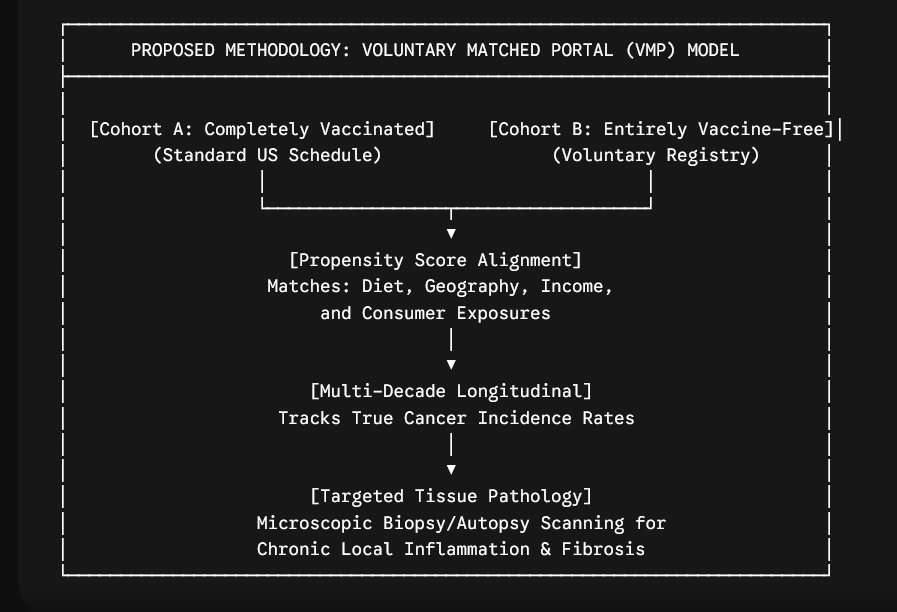
6. Comprehensive Technical References
Peer-Reviewed Literature & Computer Modeling
Peer-Reviewed Literature & Computer Modeling
Mitkus study (2013): Mitkus, R. J., Hess, M. A., & Schwartz, S. L. (2013). Pharmacokinetic modeling as an approach to assessing the safety of residual formaldehyde in infant vaccines. Vaccine, 31(25), 2738–2743.
Link: https://pubmed.ncbi.nlm.nih.gov/23583892/
Epidemiological Data & Cancer Registries
National Cancer Institute (NCI) SEER Explorer: Surveillance, Epidemiology, and End Results (SEER) Program Cancer Statistics.
Link: https://seer.cancer.gov/statistics-network/explorer/
Journal of the National Cancer Institute (JNCI) Trends: Racial and ethnic and socioeconomic disparities in childhood cancer incidence trends in the United States, 2000-2019.
Link: https://academic.oup.com/jnci/article/115/12/1576/7235569
Official Carcinogen Classifications
IARC Monograph 88: International Agency for Research on Cancer (2006). Formaldehyde, 2-Butoxyethanol and 1-tert-Butoxypropan-2-ol. Evaluation of Carcinogenic Risks to Humans.
Link: https://www.ncbi.nlm.nih.gov/books/NBK326468/
National Toxicology Program (NTP) Listings: Report on Carcinogens, Twelfth Edition. U.S. Department of Health and Human Services.
Link: https://ntp.niehs.nih.gov/
Environmental Assessment Profiles
ATSDR Toxicology Index: Agency for Toxic Substances and Disease Registry. Toxicological Profile for Polybrominated Diphenyl Ethers (PBDEs).
Link: https://www.atsdr.cdc.gov/toxprofiles/
EPA Environmental Guidance Databases: United States Environmental Protection Agency Core Risk Assessments.
Link: https://www.epa.gov/
Public Health Explanations
CHOP Vaccine Education Center Documentation: The Vaccine Education Center at the Children's Hospital of Philadelphia Information Sheet on Formaldehyde.
Link: https://www.chop.edu/vaccine-education-center/vaccine-safety/vaccine-ingredients/formaldehyde
Manufacturer Source Documentation
FDA Product Approvals Index: Full structural data, excipient limits, and individual manufacturer package inserts (such as GSK's Infanrix, Sanofi's Daptacel, or MCM's Vaxelis) can be searched and cross-referenced here:
Link: https://www.fda.gov/vaccines-blood-biologics/vaccines
We are human and can make mistakes too. If you find something incorrect, feel free to point it out to us, and we will check it to see if your input is valid. We will not argue with any of you. Please be able to provide factual evidence, not a narrative.